Monday, September 23, 2013

Barn Art -- A New Series

I recently started a series of painting/sculptures for the outside of the converted barn I live in. I've never seen anyone else making anything like these so I figure they must be original. I'm not sure why I started or even what I'm doing. I have no plans or ideas, I'm just trying to follow the inspiration wherever it takes me with out any judgement. I think they are fun, I like how they alter the look and impact of my building. They change it from a drab structure to something that is different and unexpected. I like that. I can't tell whether they are good or bad, or whether anyone else likes them, and I really don't care. For me, it is just enough that they are what they are.

Below is the first one that I made in early August. It was made with all the cut-out circles I had left over from Box of Courage I made for the Exposed show in Stowe, VT back in June. I haven't titled any of these pieces yet and I'm not sure of the measurements either, I think not knowing these things is part of the fun. The front door this one hangs over is about 44" wide though, so this piece must be around 55" inches wide.
Untitled
exterior latex paint and 5/8" underlayment plywood
39" x 58" x 3"
August 2013
This one is more of a pure painting but it is done on the old hay bale door I pulled off the barn about nine years ago. I rediscovered it recently as I was cleaning up my stacks of stored lumber. When I found it I was entranced by the peeling alligator pattern of the old lead paint so I took off whatever wanted to be removed and used the door as a found canvas. The stripes are painted along the strips of tongue and groove boards used to make it so the colors just emphasize the pattern that already exist. I did measure this one and was surprise how large it is.
 Untitled
exterior latex paint and stains on old hay bale barn door
48" x 45"
August 2013
This piece was made with some scrap pieces of 3/4" underlayment plywood that I repurposed after 8 years of service as snow/ice protection for a couple of A/C compressors. When I finished it, I really didn't know what to think but it has grown on me, a lot. It has inspired me to make a similar style piece for indoor walls.
Untitled
exterior latex paint and stains on 3/4" underlayment plywood
55 x 54" x 2"
September 2013
These last three pieces were made with a repurposed sculpture I made last year for Art Hop. The old piece inspired this year's Box of Courage but I didn't feel it was nearly as good and I no longer had the desire to display it so I cut it up into geometric shards with no idea how they would be reassembled, only the assumption that something good would come of it. I was really surprised and very pleased with the results. In fact, I didn't have any idea how figurative this first piece was until a couple of days after I assembled it. To me, it looks like, if there were such a thing, one of Caesar's armored hippopotamus soldiers practicing yoga. Very funny. 
Untitled
exterior latex paint and stains on 5/8" underlayment plywood
63" x 45" x 2"
September 2013
I hadn't realized the figurative nature of this one until I had finished either. To me, it seems something like a Picasso portrait.
Untitled
exterior latex paint and stains on 5/8" underlayment plywood
61" x 37" x 2"
September 2013
And this last one seems more purely abstract but has a figurative element as well. I think that tension of being right on the edge of a figure makes it more interesting.
Untitled
exterior latex paint and stains on 5/8" underlayment plywood
45" x 31" x 2"
September 2013
Here is a view of the overall structure. The small window on the right side is where the original hay door was located.

At this point I either need to buy another barn or start selling these things because, unfortunately, I've run out of exterior wall space and I still have some pieces I'd like to finish. Marketing something like this can be problematic though. By nature, it isn't something that would hang on a gallery wall and aside from telling friends about it on Facebook, how do you get the word out? Maybe I should start a blog!!!

Thursday, September 12, 2013

Of Land and Local Exhibit Organized by Burlington City Arts

I have two pieces in a show titled Of Land and Local that has been organized and curated by DJ Hellerman of Burlington City Arts. The exhibit is spread over seven venues around Vermont. My pieces, The Revolution Will Not Be Televised and Thrice in a Lifetime, will be on exhibit at the Carving Studio and Sculpture Center in W. Rutland September 14 through October 27. The opening reception is on the 14th from 4:00 to 5:30.
 The Revolution Will Not Be Televised
shellac on wood
36" x 49" x 1.5"
2011
Thrice In A Lifetime
shellac on wood
36" x 36"
2008

Tuesday, September 10, 2013

Another Juried Show Award

For this year's Art Hop in Burlington, VT, I submitted my piece Celebration for the outdoor juried show. It had been on display at the Vermont Arts Council in Montpelier for a couple of years but that exhibit had run its course so I was happy to find another location, which turned out to be in front of Lake Champlain Chocolates on Pine Street.
Celebration
northern white cedar and metal hardware
47" x 152" x 152"
2011
The exhibit was juried by Pavel Zoubok, of his eponymous Chelsea gallery, so I was doubly pleased to be awarded second place and receive my second Art Hop juried show award. I try not to put to much value in juried shows, but I can't say that the recognition isn't nice and I'm certainly not going to complain about the cash prize either.

Monday, August 26, 2013

Trip to Bishopville

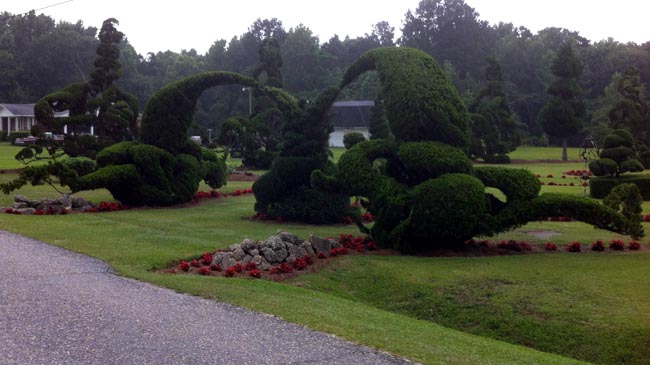
While in South Carolina in June, I took a four hour detour to Bishopville in order to see Pearl Fryar's remarkable topiary. I had first learned of his work through a documentary film (A Man Named Pearl) I came across a couple of years ago. I don't think I ever heard the word "topiary" before seeing the film and one of the interesting aspects of Pearl's work is that he had been making his plant sculptures for years before he learned the word either. In summary, Pearl started his art installation in 1980, at the age of 40, without any background in horticulture or art, just an intuitive sense and an obsessive desire to create something sensational.

Pearl would work his day job, (I think at a local Coca Cola bottling plant) and then come home and continue working late into the night -- midnight, 2 am, whatever it took to realize his vision.

After about ten years of work, his two acre plot started to get local notoriety. He had hoped to win the Bishopville Garden of the Month award but, because he lived outside the city limits, was not eligible; however, (if my memory is right) a local state senator, after seeing his work, told the garden club that if he didn't win the award, they should just stop giving it out, so he finally won.

Pearl worked with plants that had been discarded by the local nursery, finding trees and bushes for free and, because he didn't know not to, doing things that no knowledgeable horticulturalist would try; thus, his work is inventive and unique.
While visiting, I was fortunate to meet Pearl and found him to be extraordinarily generous with his time. He spent an hour with me, talking, showing me his work, and giving me tips on how to create my own tree/bush sculptures.

These days, he gets about 10,000 visitors a year wondering around his property (thankfully, a public restroom was installed by Coca Cola -- I think they were the sponsor), and Pearl spends most of the day time talking to visitors, then, continues to work through the night maintaining and improving the installation. There is no charge to visit, however, if one wants to make a donation, there is a box at the front where you can leave something. This isn't, has never been, and likely never will be, a profit-making endeavor. Pearls mission, and the destination of all proceeds he collects, is to support scholarships to a local community college so that underprivileged youth can get a opportunity to a higher education -- so if you can give a donation, anything you can provide is appreciated, but all are welcome to visit, regardless of ability to pay.
These days, Pearl has some sponsors that help him maintain his property, including, John Deer, Waffle House, Coca-Cola, and McDonalds (I think). He also has an intern that gives him about 20 hours/week. Still, at the age of 74, Pearl doesn't seem to have slowed down much. He is in fantastic shape and is in constant motion, keeping everything just right.
 
Originally from Clinton, North Carolina, Pearl said that although he always had creative leanings in school, with an intense interest in art and drawing, his artistic education was actively discouraged and he ended up getting degrees in Chemistry and Math. After school, he first worked for a Coca-Cola bottling plant in Upstate New York and was later transferred to a plant in Bishopville.

Pearl's sculptures seem to fall into two categories, the more rigid, tight, geometric kind, often made along the themes of triangles and pyramids, like below:


And the more free-form, experimental work that are completely original designs, seeming to have been made for the simple pleasure of creating unusual shapes, like these:

The one below is my absolute favorite, and is a combination of the two styles, free-form but still made with tight, beautiful bubbles.
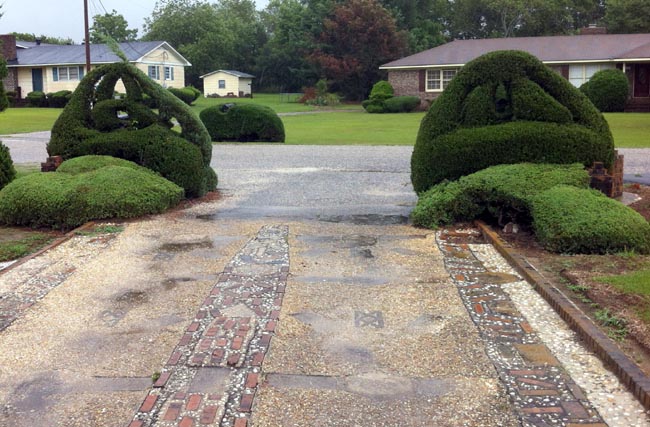
Below are a few images to give you a better idea of the lay-out and surrounding property. This one is a side view of the exit from Pearl's drive.
Pearl's property is consists of two side by side (approximately) one acre lots. The image below is the "gateway" to the lot to the left of his house lot.

Below is a straight on view of the exit.
And this is looking out from the exit, toward the neighbor's lots.
Behind the "gateway" of Pearl's side lot he has verbalized the inspiration for all his art, "Love, Peace, and Goodwill."


After Pearl installed these topiary numbers, his address was changed to 145, but since it was too difficult to change, he has left it as is.   
Below is a work in progress. You can see that Pearl trains the vegetation to grow on PVC piping that he has painted black. To anchor the PVC, Pearl first uses pieces of rebar as steaks that the PVC fits over. He then attaches the vegetation to the PVC with little plastic ties.
So that birds will feel welcome, Pearl has also installed a custom bird house.
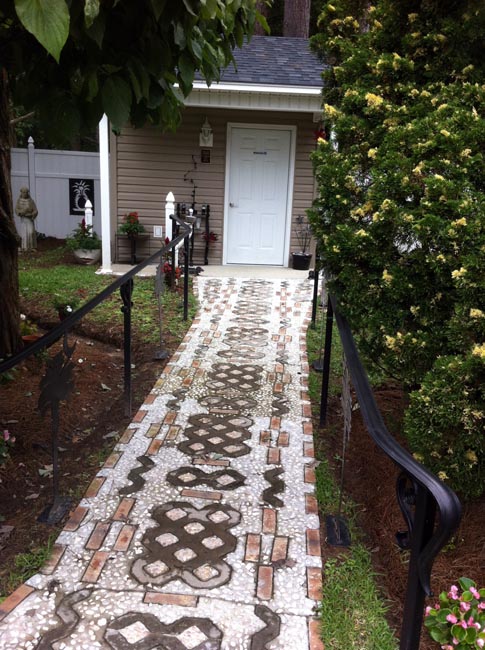
And, as mentioned earlier, there is a public restroom on the grounds, built with a donation from Coca-Cola(?).
And here is one final image of Pearl, with one of his fountain sculptures, in front of my favorite topiary. I highly recommend a visit to his topiary, certainly if it is within a four hour drive. There are so many tourist attractions wherever one travels and so few truly authentic sights that are open to the public. Pearl is so unbelievably welcoming and so generous with his property. It is truly heart-warming how much love he instills in his work and how dedicated he is in using this vision to do some good in the world. I hope his example inspires many more Pearls in the world.

Monday, July 15, 2013

Furniture With Soul II @ Gallery NAGA

This summer Gallery NAGA has organized a second show of artists featured in David Savage's book, Furniture with Soul: Master Woodworkers and Their Craft. For background, you can see the review I wrote last year here. As an added bonus, the show features even more artists from the other side of the Atlantic whose work is rarely seen in the US.

This year's show is equally great, with plenty of stunning work that truly push the boundaries of what furniture is and how it relates to art. Interestingly, I found my favorite piece to be one that was more conceptual than the others. Yuri Kobayaski's Being is emotionally powerful, conveying a tension between what is public, for everyone to see, and what is private, that perhaps we don't have a right to know about. It can be simply viewed as a chest of draws, however, it is really much more complex. Without any walls to protect the interior, the viewer can look right through it as if it has nothing to hide;
Being
ash
108" x 17" x 11"
2005
Yuri Kobayashi
In contrast, the small draws feel very intimate and private, as if they hold secrets, even though they are totally exposed. I found this contrast scary and uncomfortable, while at the same time, admirable. Additionally, notice how it is difficult to tell where the top ends. It seems to fade to nothingness, as if there is no separation between it and everything else. It is borderless/endless but still, very small and personal.
Being (closeup)
I also love her second piece, Current, and believe it is the equal of anything else in the show in spite of it being the smallest and "simplest" work on display. Though minimalist in design, it is skillfully constructed with a surprisingly technical complexity. She had taken nine strips of ash and bent them so that each piece retains its individuality as it rotates from being glued edge-to-edge on the left side to being glued top-to-bottom on the right.
Current
ash
18" x 45" x 7"
2013
Amazingly, as they shift, each strip has terraced edges rather than being sculpted smooth.
Current (second view)
The edges are most visible in the image below. Notice how the thickness of the strips also decreases as they overlap so she is able to maintain the full length of the strips without an incongruously thick stem.
Current (closeup)
Also notice the elegant finish to the stem.
Current (closeup)
Though Yuri's sculptures are certainly standouts, a number of pieces were exceptional by any standard of design or technical execution. Of particular note is Marc Fish's Mollusque. Unfortunately, the images I thought I took seem to have disappeared so I grabbed them from the gallery's site.
Mollusque
sycamore, glass, copper
32" x 72" x 41"
2012
Marc Fish
It is a phenomenal piece, made with copper and wrapped with sycamore (probably English sycamore, which is linguistically a little confusing because it is actually a maple - Acer pseudoplanunus). Amazingly, the wood is thin enough to fold around the tight curve but thick enough to carve ripples (and for this I wish I had my images) all around the piece, perhaps and 1/8" deep, that create an illusion of a beach-worn shell surface.
Mollusque (second view)
Curiously, in contrast to last year's show that had two equine pieces, this year there are three mollusks. The second one is by Joseph Walsh, also a low table sculpted as a weathered shell, again with a textured surface.
Erosion I - Low Table
rippled ash, olive ash, white oil
21" x 67" x 35"
2009
Joseph Walsh
With the treatment of the surface and the whitening (with oil) he is able to mimic the look of a time-sculpted shell.
Erosion I - Low Table (second view)
The third mollusk inspired piece is Alun Heslop's Razorfish (table). Again with a white ash, the piece resembles a wave sculpted sea floor with the razorfish making up the legs, seemingly poised to pop out of their holes. 
Razorfish III
ash
21" x 73" x 24"
2013
Alun Heslop
From underneath you get a better view of the holes. They remind me of Bart Niswonger's work, and perhaps were carved with the use of an industrial drill press, as Bart does.
Razorfish III (underneath)
Daniel Lacy's Chestless is innovative and interesting in how it is constructed without a chest for the draws to fit into. Instead, the draws slide on a rail system that is invisible from the front.
Chestless
British cherry, ash, Lebonon cedar
58" x 15" x 21"
Daniel Lacey
From the rear you can see how the draws slide. In addition, by creating a decorative crevice along the side that can be used as a handhold, he is able to maintain a sleek, clean line (void of handles) along the front.
Chestless (second view)
Michael Puryear's Asian influenced desk and chair combination, Win Jinan Shifu, is light in color and design. The seat and table top float above their bases as if levitating, creating a magical element to the work. 
Wei Jinan Shifu (chair)
English sycamore, wenge
30" x 29" x 22"
2005
Michael Puryear
Wei Jinan Shifu (second view)
Both pieces are impeccably designed and executed. I particularly like the high contrast lumber selection. Often I find this combination to be too jarring, but here, perhaps because the dark wenge helps to create an additional illusion of floating above the floor, it is particularly appropriate.
Wei Jinan Shifu (desk)
English sycamore, wenge
29" x 60" x 20"
2005
Michael Puryear
With this close up of the desk top, you can see the highly figured boards he used.
Wei Jinan Shifu (desk - closeup)
The last piece that I'd like to highlight is Reveal Chest of Draws by Waywood, a small team of furniture-makers in Chadlington, UK. It has such beautiful, flowing surfaces, again, uninterrupted by handles. It obviously inspired by nature but, at the same time, is elegant and contemporary.
Reveal Chest of Draws
walnut, maple, oak, Lebanon cedar
55" x 28" x 20"
2010
Waywood
From the side you can also see the handholds that allow for easy opening, and the decorative joining technique used in the draw fronts.
Reveal Chest of Draws (closeup)
And finally, I have to congratulate Gallery NAGA for curating such an ambitious, and expensive, show for the second year in a row. The logistics of working with so many artists from so many different places -- including the shipping, handling, and promoting -- is a remarkable feat that matches the accomplishments of the participants. It has been such a treat to be able to see, and touch, work that I would, otherwise, not even know about.