Showing posts with label Christy Oates. Show all posts

Wednesday, June 8, 2016

Crafted: Objects in Flux @ Boston MFA

The Boston MFA's exhibit Crafted: Objects in Flux (August 25, 2015 to January 10, 2016) challenged and effectively obliterated the false dichotomy between craft and art in a way that reminds me of the 40 Under 40: Craft Futures show at the Renwick Gallery in 2012. This exhibit, curated by Emily Zilber, goes even further by including artists of multiple generations and multiple nationalities. The show is also very important in breaking down the barriers between "craft" and "art" because, surprisingly, it is the first time an exhibit of this kind has been held in an encyclopedic museum.

My favorite work in the show were these pyrographs by Japanese-American artist Etsuko Ichikawa.
Etsuko Ichikawa
Trace 2012 and Trace 2112
glass pyrographs on paper
The pyrographs themselves are both beautiful and interesting but what makes them truly great is watching the accompanying video that shows how Etsuko makes them -- by snaking molten glass on paper and using an immense amount of skill in creating beautiful designs without causing the the entire effort to go up in flames. Part dance, part performance, part glass making, the end result is a work that captures a unique moment in time.
Etsuko Ichikawa
still from glass pyrograph video
Etsuko Ichikawa
still from glass pyrograph video
Charlotte Potter's Pending is an interesting conceptual piece. She projected a map of the US on the wall and placed a cameo pendant of her pending Facebook friend requests on their location.
Charlotte Potter
Pending
hand-engraved glass cameos, metal, images courtesy of Facebook
The length of the rod is proportional to the number of their mutual Facebook friends. Additionally, she very skillfully carved the image on the cameos from her friend's Facebook profile picture.
Charlotte Potter
Pending (closeup)
Greg Payce, a Canadian artist, sculpts amazing negative space images with porcelain vases that he throws by hand. Unfortunately, because I hate reading wall text in museums, I totally missed the images he creates and, consequently, didn't get a good picture of the actual vases in the exhibit.
Greg Payce
Adam and Eve
Two lenticular photographs of porcelain vases
Christy Oates often ties the traditional decorative furniture technique of marquetry with conceptual art. Here she has created work that you might expect to be made for the top of high-end furniture but they are designed using a computer algorithm based on the top trending Google news story of the day. There were fifteen pieces on display representing fifteen days in September 2011.
Christy Oates
Kaleidoscope Algorithm
Fifteen segments in various woods
Thankfully, there was an accompanying video to clarify her process.
Christy Oates
still from Kaleidoscope Algorithm video
Similarly, Alison Elizabeth Taylor uses the same traditional technique to "paint" a very different type of contemporary commentary.
Alison Elizabeth Taylor
Tap Left On
wood veneer, shellac
Her work often deals with working class issues, which is an interesting contrast to the "craft" typically used as decoration for economic elites.
Alison Elizabeth Taylor
Armstrong Congoleum
wood veneer, shellac, aluminum
Chien-Wei Chang, a Taiwanese-British artist, created this Huge Ladle (I'm guessing it is about five feet long). With it he plays with the concept of craft objects being functional. Additionally, his ladles are conceptual, relating to his own journey of emigration -- being scooped out of one container and being placed into another. 
Chien-Wei Chang
Huge Ladle
silver plating, padauk wood
Faig Ahmed is an artist from Azerbaijan who uses traditional rug making techniques and styles of his culture as a launching pad to visually tie the past with the present.
Faig Ahmed
Invert
Handmade woven carpet
With her Hair Craft Project, Sonya Clark honors artists that are traditionally overlooked and under-valued. Over a one year period she visited eleven hairdressers and had them create their art in two forms, ephemerally on her head and permanently on canvas.
Sonya Clark
The Hair Craft Project
Hairstylists with Sonya
color photographs
She also photographed the artist with their creation, thereby literally and metaphorically standing up for the work so that it can be seen as museum quality art. 
Sonya Clark
The Hair Craft Project
Hairstyles on Canvas
silk threads, beads, yarn, shells on canvas
Astrid Krogh is a Danish artist who created this beautifully woven optical fiber "fabric." The title, Ikat II, refers to a technique of resist dying that allows subtle bleeding of the colors, similar to how the different color light fibers interact with each other. As such, it is a work that is equally contemporary and traditional.
 Astrid Krogh
Ikat II
woven optical fibers, paper yarn, light monitors
With this closeup you can more clearly see the weaving pattern and the subtle bleed of color caused by the interaction of light.
Astrid Krogh
Ikat II (closeup)
In all there were forty-one artists in the exhibit representing an amazing amount of diversity in styles, techniques, and background. The quality of work was great but what I truly loved was seeing a major fine art museum breaking down barriers between it collections and expanding the definition of what "fine art" means. 

Tuesday, November 13, 2012

Craft Is Dead . . . Long Live Art

There is a great (and by "great", I mean fantastic!) exhibit at the Renwick Gallery in DC on display until February 3, 2013. Titled, 40 under 40: Craft Futures, it features forty artists under forty years old and has been assembled as an anniversary show in celebration of the museum's fortieth year of operation. Though it was conceived as the Smithsonian American Art Museum's home its "craft and decorative arts" program, I've always wondered how or why certain pieces are deemed "craft" and assigned to the Renwick Gallery, and how other pieces are deemed fine art. Certainly, a Sam Maloof chair, or an Edward Moulthroup turned vase are classical craft pieces, but why are iconic Renwick pieces like Wendell Castle's Ghost Clock or Larry Fuente's Game Fish so deemed? Likewise, why is an artist like Alexander Calder, who worked in metal and wood, and made many works of jewelry, deemed a fine artist. Or why is an artist like Martin Puryear, who uses boat building and furniture making techniques in his wood sculptures, never seen along side pieces by someone like Matthias Pliessnig , who uses similar techniques to create furniture? Is Roy Lichtenstein's Brush Stroke Chair fine art and Judy Kensley McKie's Monkey Settee craft? The truth is, there is no way to define fine art or fine craft that is exclusive of the other and trying to do so only sets up a false dichotomy that has no useful purpose. In the end, art is art and we should evaluate it based on our reaction to it, not by the materials used, the market value, or the history of the artist.

So I was elated to see the current exhibit at the Renwick -- one that I hope everyone should see (and by "everyone", I mean everyone) because the curator, Nicolas Bell, has totally ignored the dichotomy, selecting work based on quality and ignoring, all together, any definition of "craft" other than one that embraces work that is well made.

For example, Shawn Smith's pixelated sculpture of a camp fire, made with small cubes of plywood, titled Between 1 and 0, is much more conceptual than it is aesthetic, and in no way would one normally expect to find it in a show of "craft". 
Between 1 and 0
plywood, acrylic paint, ink
2011
Shawn Smith
Smithsonian American Art Museum collection
Gift of the Washington Design Center; Museum purchase through the Richard T. Evans fund
(photo: Teresa Rafidi)

And Dave Cole's piece, Evolution of the Knitting Needle Through Modern Warfare, is also conceptual, though it does have a tangential association with craft in that he has sculpted a crafting tool, knitting needles, in it. The sculpture is a hypothetical historical look at what knitting needles would have looked like if they had been issued by the US military since the Civil War. It is an amusing and thoughtful piece that you can best see it on his website here.

As an interesting twist on craft versus art, Stephanie Liner's work is a craftcentric conceptual piece that is, in part, about the furniture industry in the south eastern US as well as the fashion industry. For the exhibit, she has a giant egg shaped upholstered furniture/dress on display that a woman can "wear." It also has a window in which viewers can voyeuristically look in (the images on her website give a better understanding of the sculpture).
  Mementos of a Doomed Construct (closeup)
upholstery, plywood, fabric, sequins, yarn, embroidery, adhesive, cardboard
2011
Stephanie Liner
Courtesy of the artist
(photo courtesy of John Michael Kolher Art Center)
  
And then there is Melanie Bilenker's amazing drawings with hair, like Dresser Drawer. Yes it is technically a brooch, and yes, she is technically a jewelry maker, but her work is so much more than jewelry -- it is contemporary art that just happens to be wearable. Its functionality seems to be more of an afterthought or coincidence. By wearing it, the owner becomes a walking art exhibit. Incidentally, the piece is much smaller in person than the image below would imply. To make this "drawing," Melanie would have to have the manual dexterity of neonatal heart surgeon.
Dresser Drawer
2" x 2" x 1/2"
hair, paper, wood, gold, crystal, brass
2011
Melanie Bilenker
 Smithsonian American Art Museum collection
(photo: courtesy of Sienna Gallery)

In contrast to other conceptual artists in the exhibit, Laurel Roth uses a traditional "craft" technique (crocheting) for conceptual purposes. With her Biodiversity Reclamation Suits she has created costumes to disguise common urban pigeons as extinct birds, thereby reclaiming them.
Biodiversity Reclamation Suit: Carolina Parakeet
suit: cotton, silk, bamboo, wool, acrylic blends; mannaquin: hand-carved basswood, acrylic paint, gouache, glass eyes, metal legs, walnut stand
8" x 9" x 13"
2009
Laurel Roth
Courtesy of the artist and Frey Norris Gallery
(photo: Andy Diaz Hope)

 Biodiversity Reclamation Suit: Carolina Parakeet (closeup)
The quality of her "craft" in sculpting and crocheting is exquisite, but the loving/bittersweet humor in the concept of the work is what makes it really special. (Note: The Renwick is hoping to purchase at least one of these birds for their permanent collection through micro donations of $10 or more from the general public. They are really great pieces so, hopefully, they will reach their target. You can learn more at this link.)
Biodiversity Reclamation Suit: Passenger Pigeon
suit: cotton, silk, bamboo, wool, acrylic blends; mannaquin: hand-carved basswood, acrylic paint, gouache, glass eyes, metal legs, walnut stand
8" x 9" x 17"
2008
Laurel Roth
Courtesy of the artist, Frey Norris Gallery, and Schroeder Romero and Shredder Gallery
(photo: Andy Diaz Hope)
 Biodiversity Reclamation Suit: Passenger Pigeon (closeup)
And in Food #6, Pistols, you can see the beauty of her unadorned wood sculpture -- in this case a jaw bone of a fairly small cow that references a pair of dueling pistols. Is it craft because it is made of wood? No, it is in a "craft" show because it is made so darn well!
Food #6, Pistols
pistols: walnut, gold leaf, Swarovski crystals, bronze
case: velvet, walnut
20" x 15" x 3.75"
2009
Laurel Roth
Courtesy of the artist, Frey Norris Gallery
(photo: Andy Diaz Hope)
Thankfully, the curator also included works in the show that are classically seen as "craft," thereby further helping to tear down the false dichotomy of art and craft. Matt Moulthrop's untitled wood turning is an example of this,
Untitled
red maple
2008
Matt Moulthrop
Smithsonian American Art Museum collection
Gift of Dan Greenberg and Susan Steinhauser

 as is Jamin Uticone's black ash woven basket.
Urban Pack Basket
black ash, vegetable-tanned hide, brass fittings
2011
Jamin Uticone
Smithsonian American Art Museum collection
Gift of Martha G. Ware and Steven R. Cole 
Both of these artists apprenticed for long periods to learn their chosen fields (Matt for nine years and Jamine for six) but, regardless of the functionality, or lack there of, of their products, their work is remarkable as much for its devotion and vision as it is for its artistry.

Likewise, there are a number of participants in the exhibit that straddle the line between traditional craft and fine art. Including Jeffrey Clancy, whose Tea For One at first appears to be just a funny looking gun but in reality is an art teapot. Technically, it is functional but its function isn't the point, rather, its high level of craft helps the artist make a statement. It is beautify, humorous, and poignant all at once.
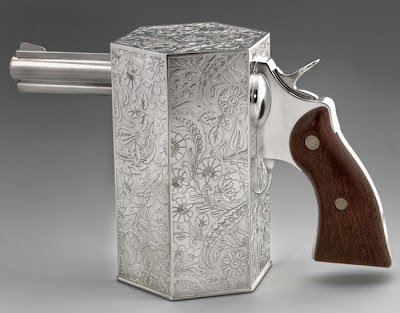
Tea For One
silver and mahogany
6" x 10" x 4"
2002
Jeffrey Clancy
Smithsonian American Art Museum collection
purchase made possible by the Charles and Margret Craver Withers Bequest
 
Andy Paiko's exquisite Spinning Wheel also falls in this category. It is a beautiful and delicate sculptural object that is perfect on its own, without being associated with any function, but it is also a fully functional object that can be used to spin yarn. The combination of the seemingly contradictory elements make the viewer see the object in a new way. 
Spinning Wheel
blown glass, cocobolo, steel, brass, leather
2007
Andy Paiko
Smithsonian American Art Museum collection
Gift of Peg and Bob Van Andel 
(photo: Andy Paiko)
 Spinning Wheel (closeup)
A video of the piece in action can be seen here. 

There is also work that leans more to function but that is designed to such a high level that it is equally fine art, such as Christy Oates' ingenious Crane Chair that, when it isn't being used as a chair, folds up and functions as a wall hanging (see more images here to understand how it works).
 Crane Chair
laser cut and engraved plywood, maple veneer, bungee cord
acrylic paint, wood dyes
2009
Christy Oates
Smithsonian American Art Museum collection
Gift of Leon and Miriam Ellsworth 
(photo; Christy Oates)
Along the same lines is her Mosquito Lamp (more images here).
Mosquito Lamp
laser cut and engraved plywood, maple veneer, bungee cord
acrylic paint, wood dyes
2009
Christy Oates
Smithsonian American Art Museum collection
Gift of Myra and Stephen Kurzbard 
(photo: Christy Oates) 
There were also two representatives of the new movement of ecologically conscience good design. Daniel Michalik's 3/1 Chair is one such object because it uses reclaimed cork (there by recycling an already renewable resource) and formaldehyde free FSC-certified plywood with low-VOC paints.
 3/1 Chair
recycled cork
FSC-certified plywood, low-VOC paint
2011
Daniel Michalik
Smithsonian American Art Museum collection
Gift of Phyllis and Sidney Bresler in memory of Charles S. Bresler and in 
honor of Fleur Bresler
photo by Daniel Michalik  
Also represented in this group is the Cyclone Lounger by Uhuru, the design team of Jason Horvath and Bill Hilgendorf, because is uses reclaimed boards from the Coney Island Boardwalk. In making the piece they did a nice job in referencing the roller coaster of the amusement park from which it came.
Cyclone Lounger
reclaimed Coney Island Boardwalk (ipe), laser cut powder-coated steal base
2010
Uhuru
 Smithsonian American Art Museum collection
Gift of Bill Hilgendorf and Jason Horvath in memory of Cynthia Bricker Hilgendorf; Gift of Fern Bleckner in celebration of Etta B. Brown's ninety-fifth birthday; and  
Gift of Shirley Jacobs
(photo: Uhuru Design)

Christy Oates' E-Waste Project piece is also ecologically conscience but more in a conceptual way than in actual materials used. In creating the piece, a highly detailed work of marquetry, she photographed the process and made a companion stop action video that highlights the issue of e-waste. I had commented on the video many months ago after stumbling across it somewhere and was blown away by the brilliance of the concept, execution, and the shear fortitude in assembling the thousands of small pieces of veneer.
E-Waste Project
12 various wood veneers
2011
Christy Oates
Courtesy of the artist
(photo: Christy Oates)
 E-Waste Project (closeup)
An interesting aspect of the piece, especially in this show, is how she takes a traditional "craft" technique like marquetry and creates it with computers, robots, and lasers. Yes, it is still a "craft," but the techniques used to make it are no more craft than an iPhone. You can view the video below to get a better understanding of the piece. Although interesting and beautiful on its own, I don't think it really makes sense as a stand alone piece without the video.

Additionally, an interesting aspect of the show are the videos that the Smithsonian American  Art Museum asked the participating artists to create videos as a way to introduce themselves to the public and, perhaps also, provide some information about their process. With forty artists, there is a lot to look at but it is well worth viewing, especially if you want to learn more about specific artists. You can see all of them here, but if you just want to look at a few, I highly recommend the videos of Christy Oates, Olek, Gabriel Craig, Shawn Smith, and Melanie Bilenker. If you look at the videos you'll notice many great artists working in many different media. I've restricted my review to works made with wood because I have to draw the line, otherwise I would be spending all my time writing. For example, what would stop me from saying how I absolutely love Vivian Beer's work, and then how do I stop from talking about Olek, or Cristina Cordova, and then it is all down hill from there.

And finally, I just want to emphasize again what a great show this is, not just in terms of the quality of individual pieces, but in the overall selection of the work. The curator, Nicolas Bell, showed a lot of courage and vision in ignoring convention.Yes, each piece in the show is great, but the sum of the works says more than the individual pieces. As a group they make a commanding statement. To me, it says that finally, we can forget about fine craft and fine art definitions and just talk about the quality of the art. Craft is dead . . . long live art.

Tuesday, December 20, 2011

Buy This Magazine

The 2012 issue of Woodwork (magazine) has been out since the end of November and, if you haven't yet pick up your copy, I highly recommend you do it soon.  Unfortunately, you'll have to find a pretty good newsstand to find it, I picked mine up at Barnes and Noble, airports are probably also a good bet as well as some woodworking tool stores. If you can't find a newsstand with it, it is still worth ordering directly from their publisher, which I did last year because, even at an additional $8 for shipping, it was still cheaper than making a special trip to Burlington.

Would that it came out more than once a year, as it used to, but I know to at least be thankful that it is still being published. Thankfully, this issue has a dearth of "how to" articles. As far as I'm concerned, the step by step instructions of building someone else's design that are typical mainstays of woodworking magazines are really boring -- I always skip them. Instead, Woodwork focuses on wood artist profiles, thoughts, and history, as well as inspirational and enthralling photos of contemporary wood art from various shows around the country. 

As a yearly publication, it probably isn't the best venue for serial story telling but, interestingly, Toshio Odate is doing just that with his fascinating story about "Mighty Oak," a tree with an almost six foot diameter trunk. Last year he explained how he came upon and transported it to his property; this year is he covers the process of cutting a six inch slab from its center. I'm guessing that next year we'll learn how he turned it into a magnificent table. It is unfortunate that we need to wait years to learn the whole process but, nonetheless, I love the story and learning about how he translates his deep respect for the tree into his art.  

Also, as a semi-continuation from last year is another thoughtful essay by Mark Love. Last year his piece titled Risk discussed how the potential for making a mistake, and losing hours of work, makes furniture making more interesting; this year, in his essay titled Temporary, he talks about how finding an old and forgotten brick mosaic in his backyard related to his career path and the quality of work he now makes. 

There are several artist profiles that provide great lessons in perseverance for aspiring artists. Of particular interest is Terry Martin's piece on Todd Hoyer because it is more than biography -- it gives his work context by showing how his biography has been reflected in his sculpture.

I also found the Katherine Adams piece on Christy Oates's furniture fascinating because it provides in depth insight into her process and methods. For instance, it is interesting to learn that her love of origami and her practical need to furnish a small apartment inspired her ingenious wallpaper furniture (a recent acquisition by the Smithsonian Museum of American Art).

Several articles also provide historical stories that help to give context to contemporary furniture; for example, Peter Korn's discussion about the influences of Alan Peter's designs on his own work; the article by Caroline Hannah and Mark Sfirri on Henry Varnum Poor and his close relationship with Wharton Esherick; and Tom Casper's discussion of Henry Lapp's19th century sketchbook.


Overall, the magazine is a well written, full of beautiful images, and educational. It provides a valuable resource for learning both about contemporary wood art, and the artists behind the work, as well as historical information that enriches our understanding of current work. I believe it is well worth buying, even if you don't associate yourself with woodwork, because it provides valuable insight for anyone interested in art in general. 

Wednesday, April 20, 2011

Absolutely Brilliant

I'm not a big Facebook person. I never would have joined if not for my brother and I've never been a significant participant, though I check it occasionally. But then I found this Christy Oates video through a Furniture Society link and now I have finally come to realize that Mark Zuckerberg has created something with more cultural importance than being able to sporadically see nephew and niece pictures/videos.

E-waste Marquetry Project from christy oates on Vimeo.

I look at a lot of art and though I often see things I like, what I find really special about looking is finding that rare piece that is so spectacular that it totally captivates my attention. This is one such piece. A perfect combination of traditional craft with modern technology; fine art and craft; human vision and computer precision; found objects with meticulous planning; and, most interestingly, it brings together conceptual art with aesthetic art. Like Rich Tannen's Tray in Maple that I saw last year at a Furniture Society show, it could not be made without computers but it still retains an elegance that can only be created with intense human design and oversight.

I think it should also be seen as a multimedia piece. The video is as much a work of art as the final product. Had she simply written a paragraph explaining the process it would not be as fascinating. The video does so much more than explain, it gives the work context.

Being completely captivated, I email Christy to get some details. So that she isn't inundated with the same questions, here is what I learned:

-- The video compresses only 40 minutes of the assembly but putting it together actually took 35 hours; she spent another 40 hours setting up the files for laser cutting and the entire process took about 120 hours over three months.

-- There are 145 pieces in each section, the first section was mirrored, then the pair of sections rotated 9 times create a total of 18 pie-shaped sections. There is a total of 2610 shapes in the entire piece. The smallest shape is 1/16” square.

-- This is a non-functional piece of fine art (looking at her other videos, it is a question that you have to ask
).

-- It is finished with Watco's danish oil.

-- She used epoxy glue and pressed the veneered pattern, a thick paper surround, and a backer to a panel of mdf using a vacuum bag. The white border you see in the picture is a picture-framing matboard which is also laser-cut to fit the perimeter of the piece. It just lays on top of the substrate and hides the paper surround. She will be making a frame for it to hang on the wall.

As more background, Christy recently attended Wendy Maruyama's prestigious studio furniture MFA program at San Diego State University and has already garnered a number of prestigious awards. Most prominently, she has been included in the Smithsonian's Renwick Gallery 40 under 40 exhibit (July 20, 2012 to February 3, 2013). Although she just finished the piece last week, it is already spoken for. After seeing the video, the Renwick Gallery curator decided to switch one of her furniture pieces out so that they can display this piece. Hopefully, they will also find a way to display it with the video. I look forward to seeing it in person and posting more images.

Absolutely Brilliant!