Showing posts with label Wendy Maruyama. Show all posts

Saturday, December 8, 2012

Wendy Maruyama's Executive Order 9066

"Important" is the best one word description for the Wendy Maruyama exhibit, Executive Order 9066, which was organized by, and debuted at, The Society of Arts and Crafts September 8 to November 3, 2012. In this body of work, Wendy has focused her considerable talents on highlighting the internment of 120,000 Japanese Americans during World War II through the executive order issued by FDR. It is a sad, but often forgotten, part of our history, so Wendy has done a great service to bringing the event back to life so that viewers can learn about it on a visceral level through her art. This show is a wonderful example of how art can be used to teach history without being without being dogmatic or preachy.

The first piece to encounter was this representative of The Tag Project in which Wendy recreated, with the help of dozens of volunteers, the tags issued to each of the interned Japanese Americans. Organized by the ten camps to which they were assigned, there are, therefore, ten sets of tags, each with about 12,000 names attached. Because SAC's space is very limited, only one group was displayed for this exhibit, however, all should be on view at the other museum sites the show will travel to. With The Tag Project, Wendy has created an innovative and aesthetic way to convey the enormity of the internment. 
The Tag Project
paper, string, ink, thread
132" x 10" x 10"
2011
One of the things I found interesting about the series is the restraint that Wendy employed in creating the work. Hinamatsuri (Girl's Day) is a great example. For someone like Wendy, who has tremendous skill and talent in working with wood, to create something so stark and "simple" is an amazing feat in itself. Most artist look for opportunities to "show off" their skill and dazzle viewers with works they know their audience could never do. But here, Wendy is showing she cares more about conveying the stark reality internment than impressing us with works of stunning skill and complexity.
Hinamatsuri (Girl's Day)
wood, tar paper, glass, 40's era doll
26" x 48" x 3"
2011
I particularly like how she uses ripped tar paper to create something that refers to cheap, haphazard, temporary construction of the camps while also seeming to refer to abstract expressionist paintings, like Rothko's deeply emotional black series. 
Hinamatsuri (closeup)
In this piece, ID, you can see the image of a child wearing an internment tag behind a "bar" (a reference to imprisonment I assume) inside one of Wendy's art cabinets.
ID
pine, paper tags, ink
33" x 11.5" x 5"
2008
Landlocked is another "simple" piece that uses common materials, like tar paper and plywood, to convey a direct emotional experience to the viewer. 
Landlocked
wood, tarpaper, nails, found objects
25.5" x 48" x 3"
2011
Landlocked (closeup)
Land of the Free is a diptych made with sliding door cabinets, a faux functional form that Wendy has used several times for this series. It creates a variety of viewing experiences, thereby engaging the viewer to be more personally involved with the work and the past. 
Land of the Free (diptych - first section)
fir, pine, ink, plant materials
7" x 120" x 6"
2011
Land of the Free (diptych - second section)
Land of the Free (diptych - second section, second view)

The piece, Manzanar, refers to the best preserved of the camps which is now a National Historic Site. Although it is, technically, not a diptych like the Land of the Free, it also provides many viewing experiences.
Manzanar
pau ferro, fir, ink, wire, encaustic
7" x 61" x 6"
2009
Manzanar (second view)
I particularly like the curly fir she selected for the sliding doors, I assume because it refers to the mountains that over look the site.
Manzanar (closeup)
You're A Sap Mr. Jap is a black tar paper and nail "painting" that plays a continuous loop of the first Popeye cartoon, of the same name, in the lower right corner. It is a completely racist piece of wartime propaganda which you can view for yourself at this link. Again, the lack of elaborate construction of this piece makes an even more powerful statement than if Wendy dazzled us with elaborate design.
You're A Sap Mr. Jap
tar paper, wood, Popeye cartoon video
48" x 48" x 3"
2008
You're A Sap Mr. Jap (closeup)
I saw this piece, A Question of Loyalty, last year at the Fuller Craft Museum's Furniture Divas show and wrote about it here. The piece quotes what I assume was an oath that Japanese Americans needed to sign, pledging allegiance to the US. The door can be slid to reveal an answer of "YES" or "NO." It is one of the more purely beautiful pieces in the exhibit, being made with live-edge, worm-hole infested, ash.    
A Question of Loyalty
ash, ink
9.5" x 50.5" x 14"
2010
Watch Tower is another deceptive faux cabinet. With the door closed, it looks like just another nice decorative, Asian-inspired wall cabinet that any fine cabinetmaking might build. With the door open, it becomes a work of art that makes a powerful statement.
Watch Tower
pine, sitka spruce, fir, painted wood bowls, glass, ink
31.5" x 17.5" x 7.5"
2008
Zenmetsu is, again, an aesthetically beautiful piece that plays with the concepts of function, art, decoration, and meaning. The English translation of the title is annihilation. In the center, behind some glass, is a pile of broken porcelain.
Zenmetsu
tamo, ash, paper, porcelain shards
7 x 72.5 x 6
2011
Wendy used tamo, a highly figured Japanese ash, for the top and bottom of the "cabinet."
Zenmetsu (top view)
The exhibit also includes historical artifacts from the camps, including some of the art of gaman, crafts and sculptures made by Japanese Americans during their internment, as well as these pieces of historic luggage. They are much more powerful when you read the names on them: June T. Watanabe; Lillian Sasaki; Gii Yoshioka; K. Hongu. I read the names and I think, "Really? Lillian Sasaki intimidated you so much you had to ship her off to an internment camp in the middle of a desert? What could she do? Knit a sweater with her coordinates in morse code?" It helps to clarify how irrational and senseless this part of our history was, and a good reminder to how vigilant we need to be against letting our fears create such irrationality in the future.

Executive Order 9066 will travel to four additional venues into 2015 and I highly recommend seeing it if you get a chance. Here is the schedule:

Arkansas Arts Center, Little Rock, AR, February 1 to April 21, 2013

Arizona State University Art Museum, Tempe, AZ, September 28, 2013 to January 4, 2014

San Jose Institute of Contemporary Art, San Jose, CA, March 1 to May 24, 2014

Museum of Craft and Design, San Francisco, CA, October 2, 2014 to January 4, 2015.

Thursday, August 11, 2011

Furniture Divas @ Fuller Craft Museum

I recently visited the Fuller Craft Museum in Brockton, MA to see their Furniture Divas show (on view until October 30, 2011) that was curated my Meredyth Hyatt Moses. I was excited to see the show because it includes a number of my favorite artists and I knew it would also introduce me to great artists that I didn't already know about.

In reviewing this show, I know I'm leaving out a lot of great pieces by great artists but I have focused the discussion on a few pieces that really caught my attention, for purely subjective and often inexplicable reasons. The full list of exhibit artists includes:

Vivian Beer
Polly Cassel
Gail Fredell
Jenna Goldberg
Babara Holmes
Kristina Madsen
Sarah Martin
Wendy Maruyama
Judy Kensley McKie
Alison McLennan
Sylvia Rosenthal
Rosanne Somerson
Wendy Stayman
Leah Woods
Yoko Zeltserman-Miyaji

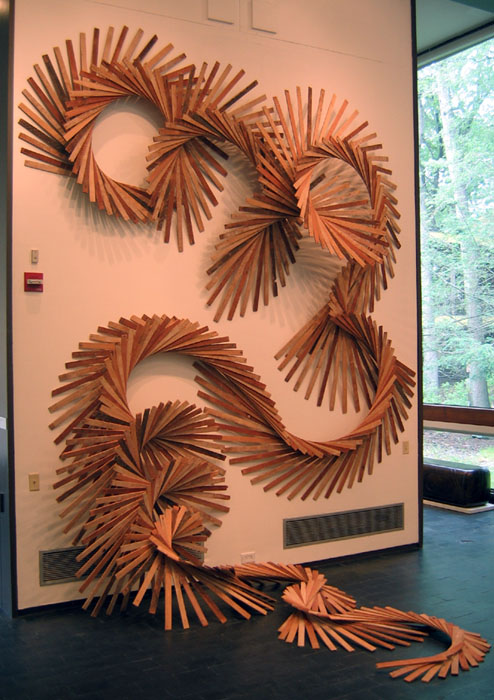
Although I'm not rating the pieces, if I were to select a favorite it would be this untitled reclaimed lath piece by Barbara Holmes -- not just because of my own personal bias toward non-functionality and cheapness of material, but mostly because of the pure joy and celebratory nature of the upward spirals. One of the nice things about the design is that it is a very organic, it doesn't follow a predictable pattern which makes it look alive as if it is climbing the wall right in front of your eyes.


Untitled
reclaimed lath
2011
Barbara Holmes


As I turned the corner into this room and looked to my right, my first thought was "What fun!" It was truly a very pleasant and unexpected surprise.
Untitled (closeup)

Also in the category of non-functionality this piece by Sylvie Rosenthal, Hope by Hope. I think it is safe to assume its title is a reference to hope chests, which I know nothing about other than what I've glanced at on this Wikipedia page. What I find most interesting about Sylvie's work is that it is pure sculpture that references furniture -- these "chests" don't open and they don't have bottoms. They seem to be calling for letters or notes (of hopes or wishes?) to be dropped into them but they aren't designed to hold anything physical so it really becomes more of a conceptual piece that asks for wishes, desires, or hopes in the form of thoughts. As such, I think it is really a meditative piece, which I believe is more valuable than something that holds stuff anyway.
Hope by Hope
2009
Sylvie Rosenthal


Additionally, in this closeup you can see how well crafted it is. The laths are made with mahogany and I particularly like their random widths, which makes the piece much more interesting. I think the birds are carved into the wood and I feel their presence plays well with the theme of the piece, perhaps in how fleeting and fragile hopes are, that they can easily spooked and fly away at any moment, never to be seen again.
Hope by Hope (closeup)

Another great piece that only has functionality in a theoretical sense (I don't think anyone would ever use it to hold anything) is Wendy Maruyama's A Question of Loyalty. It is made as part of her E.O. 9066 Series (which I mentioned in an earlier post here, in summary, the work references Executive Order 9066 which led to the interment of Japanese-Americans during World War II).


A Question of Loyalty
2010
Wendy Maruyama
The text on the sliding door reads:

Question 27: "Are you willing to serve in the armed forces of the United States on combat duty whenever ordered?"

Question 28: "Will you swear unqualified allegiance to the United States and faithfully defend the United States from any and all attack by foreign or domestic forces, and foreswear any form of allegiance or obedience to the Japanese emperor, or any other foreign government, power, or organization?"

With the door opened in one direction the answer is "Yes" but slid in the other, the answer in "No." Consequently, the viewer becomes a participant in the questionnaire that I assume Japanese-Americans must have had to respond to prior to their own internment.
A Question of Loyalty ("No" alignment)

Aside from the interesting conceptional aspect of the piece, from a design standpoint, I like the wormy ash that adds a lot of (perhaps metaphorical) character to it. It was made with "Tenafly white ash" which was a very old and esteemed ash tree from Tenafly, New Jersey that has found new life through the work of seventeen world renown artists (read the history and list of artists here). The organization tasked with preserving the tree through its second life as art, and the loaner of the piece to the show, is the Children's Tree and Art Foundation.
A Question of Loyalty (closeup)

Another sculptural piece with tangential functionality is Sarah Martin's Upward Mobility. In reading her discussion of this piece on her website, I learned that it was inspired by a record number of 17-year cicadas in the mountains of North Carolina while she was teaching at Penland School of Crafts.


Upward Mobility
2009
Sarah Martin


I was told by museum curator Perry Price, that each of the draws was a different size, fitting only in one opening, which I found interesting because in looking at the piece I wouldn't necessarily think that they were different. It is always interesting to learn about little things that artists do that only they know or care about. She could have saved a lot of time setting up her cuts to do them all the same and nobody would have known any better or have thought any less of her work, but instead, she took the time to make the draws and openings individually. It is a small but significant indication of an artists devotion to the piece and her craft.

Upward Mobility (closeup)

In addition, I'm impressed with her meticulous sculpting of all these bugs. They look almost as if she had somehow preserved the cicadas and just improved their appearance with gold and stone accessories.

Upward Mobility (closeup)

For functional pieces in the show, I was really drawn to, Gail Fredell's Bricklayer's Quartet. One reason being the fascinating slab of bog oak (a sub-fossilized tree 3,500 to 7,000 years old that was recovered from a bog in England) she used for the table top. I was also captivated by the inventive way she presents it, letting it float and be as natural as possible.

Bricklayer's Quartet
2011
Gail Fredell

It is also interesting how the bog oak's color is natural, no need to use any messy or time consuming fuming technique -- just stick a log in the ground an wait a few thousand years -- Gustav Stickley should have thought it, the result is a much richer color.

Bricklayers Quartet (closeup)

It is a little hard to see in this image but another aspect of the piece worth noting is the inventive way she stabilized the crack on the far end of the table with a steel bar underneath. A far more common method is to use a butterfly dovetail key that would span the crack, but her method leaves the crack completely natural, in all its beautiful imperfection.

Bricklayers Quartet (closeup)

I was also fascinated with this cut at the end of the board with the two small 90 degree angles. I couldn't figure out how she did it but the curator suggested, and I think he is right, that she removed a small section, perhaps rot or a large defect, and placed the section back together. Still, the shape of the cut is mysterious and intriguing, mostly because of the high level of craft she used to do it.

Bricklayers Quartet (closeup)

Another functional piece that captivated my attention is Kristina Madsen's Painted Chest. The first thing that drew my attention is its slightly diminutive presence, which I don't think translates in an image. It isn't small, but it isn't as large as you would expect it to be either. It somehow takes a scale that is unexpected, and in that way, calls attention to itself.

Painted Chest
2009
Kristina Madsen


It is also difficult to tell from the image but Kristina has intricately carved thin lines wherever you see white on this piece, the brownish yellow is milk paint. I find it interesting that she used maple for the case rather than basswood, which most people use for carving because it cuts easy and doesn't tend to tear-out. I'd be interested to know why she chose maple, perhaps because it is harder, and therefore more durable, than basswood but I wonder if it also allowed her to create thinner ridges between the grooves.

Painted Chest (closeup)

In this final image you can see the inside of the chest is lined with silk fabric but you can also get a better view of the fine carving on the outside.

Painted Chest (inside)
It is no secret that furniture making has historically been a very male dominated profession. In retrospect, it is almost hard to believe how, until very recently, exclusively male it was. In fact, I can't think of another prominent female furniture maker prior to Judy Kensley McKie's first museum shows in 1979. I even remember seeing a video of Sam Maloof embarrassingly recounting a story about how, when he first had women ask to apprentice with him (I think in the early 70's), that he had to turn them away because his employees refused to work with them. I know there were women who designed furniture earlier, such as Ray Eames and Charlotte Perriand, but women seemed to be excluded from the shop floor (it makes me think that there may be a good PhD dissertation in researching women in woodworking from earlier eras). As a result, one of the important aspects of this show is in demonstrating how unremarkable gender in the field has become. In just thirty years, women have gone from no recognition to, from what I can tell, equality (and please let me know if I'm wrong). In contrast, it is interesting to hear women in the fine art world still fighting for equality in museum collections and blue chip galleries (Joanne Mattera's Art Blog, among others, often raises the issue) but when I look at gallery and museum exhibits of furniture makers and woodworkers, women are always well represented. More than highlighting gender in the furniture world, this show seems to simply be a celebration that there are so many great female furniture makers working today that their gender is no longer relevant.

Wednesday, April 20, 2011

Absolutely Brilliant

I'm not a big Facebook person. I never would have joined if not for my brother and I've never been a significant participant, though I check it occasionally. But then I found this Christy Oates video through a Furniture Society link and now I have finally come to realize that Mark Zuckerberg has created something with more cultural importance than being able to sporadically see nephew and niece pictures/videos.

E-waste Marquetry Project from christy oates on Vimeo.

I look at a lot of art and though I often see things I like, what I find really special about looking is finding that rare piece that is so spectacular that it totally captivates my attention. This is one such piece. A perfect combination of traditional craft with modern technology; fine art and craft; human vision and computer precision; found objects with meticulous planning; and, most interestingly, it brings together conceptual art with aesthetic art. Like Rich Tannen's Tray in Maple that I saw last year at a Furniture Society show, it could not be made without computers but it still retains an elegance that can only be created with intense human design and oversight.

I think it should also be seen as a multimedia piece. The video is as much a work of art as the final product. Had she simply written a paragraph explaining the process it would not be as fascinating. The video does so much more than explain, it gives the work context.

Being completely captivated, I email Christy to get some details. So that she isn't inundated with the same questions, here is what I learned:

-- The video compresses only 40 minutes of the assembly but putting it together actually took 35 hours; she spent another 40 hours setting up the files for laser cutting and the entire process took about 120 hours over three months.

-- There are 145 pieces in each section, the first section was mirrored, then the pair of sections rotated 9 times create a total of 18 pie-shaped sections. There is a total of 2610 shapes in the entire piece. The smallest shape is 1/16” square.

-- This is a non-functional piece of fine art (looking at her other videos, it is a question that you have to ask
).

-- It is finished with Watco's danish oil.

-- She used epoxy glue and pressed the veneered pattern, a thick paper surround, and a backer to a panel of mdf using a vacuum bag. The white border you see in the picture is a picture-framing matboard which is also laser-cut to fit the perimeter of the piece. It just lays on top of the substrate and hides the paper surround. She will be making a frame for it to hang on the wall.

As more background, Christy recently attended Wendy Maruyama's prestigious studio furniture MFA program at San Diego State University and has already garnered a number of prestigious awards. Most prominently, she has been included in the Smithsonian's Renwick Gallery 40 under 40 exhibit (July 20, 2012 to February 3, 2013). Although she just finished the piece last week, it is already spoken for. After seeing the video, the Renwick Gallery curator decided to switch one of her furniture pieces out so that they can display this piece. Hopefully, they will also find a way to display it with the video. I look forward to seeing it in person and posting more images.

Absolutely Brilliant!

Monday, July 19, 2010

Historical Woods Show @ Furniture Society Conference

While wondering around the Furniture Society Conference a few of weeks ago, I came across this interesting exhibit of work by a number of famous furniture makers using trees from historically important American sites, many of which have documentation of being planted by the likes of George Washington, Thomas Jefferson, James Madison, and others. For example, Thomas Jefferson wrote a letter in 1807 in which he mentioned planting a tulip poplar in the exact location that a dead tulip poplar was removed from in 2008 and, hence, used for many of these works of art.

The exhibit, titled National Treasures: History in the Making, is the vision of William E. Jewell who co-curated the show with renowned wood artist Jacques Vesery, and has been organized by Historical Woods of America. In addition to the great furniture artists that were featured in this show, sculptural works were also made by renowned artists Binh Pho, David Ellsworth, Mark Lindquist, and Robyn Horn as well as Jacques Versery. Images of all these works are included in a very nice catalog which can be seen here.

This piece by Wendy Maruyama, titled Fractured, is part of her E.O. 9066 series, a references to the executive order President Roosevelt signed allowing for the internment of Japanese Americans. The piece is made from Thomas Jefferson's elm tree and references the fragmenting effects, both emotional and physical, of the historic event. I think, knowing the background makes it a more powerful piece, but on its own it is just really cool. I like the original nature of having the doors slide at different angles, allowing the user to create different works of art by moving them around.
Fractured
12" x 85" x 15"

Thomas Jefferson's Monticello Elm

Wendy Maruyama

Fractured closeup

Silas Kopf created this Founding Father's Writing Desk and Thomas Hucker created a complementary writing chair, Dearest Sally, both with Silas's marquetry. The desk appears to have an initial draft of the Declaration of Independence with the line, "We hold this truth to be self-evident," and "this truth" is crossed out to be replaced by "these truths". The chair appears to have a letter hidden on the lower level and folded over with only the words, "Dearest Sally" revealed. These are both classic examples of the humor Silas often imbues into his work.
Founding Fathers Writing Desk
30" x 52" x 20"
Silas Kopf
and
Dearest Sally
32" x 20" x 20"
Thomas Hucker
both made with
George Washington Whiskey Distillery Walnut
w/fifteen different historic woods for marquetry (by Silas Kopf)


Thomas also created this pair of side tables on his own. It takes the concept of pie crust tables and makes them completely contemporary. As with the writing desk chair and many of the pieces on his website, bringing traditional designs into contemporary life is something he often tends to do.
Washington Side Tables
24" x 16" x 24"
George Washington Whiskey Distillery Walnut

Thomas Hucker


Brian Newell created this scroll case because of the importance of documents to the founding of the nation and he made it out of wood associated with James Monroe and James Madison, at least in part, because of their importance in creating many of the countries early documents. The top of the case has carved calligraphic fragment lettering (difficult to visualizer from this angle).
Scroll Case
7.5" x 6.5" x 21.5"
James Monroe Boxwood and James Madison Cedar of Lebonon
Brian Newell


Garry Knox Bennett's work commonly features odd juxtapositions and this chair, made with Thomas Jefferson tulip poplar and Formica ColorCore, is no exception. He used a Rietveld Zig Zag chair design because of its distance from the Windsor-style chair and added a writing-arm because Thomas Jefferson supposedly had something to do with adding them to Windsor chairs. It is a completely modern piece and, I think, pretty optimistic because it forces the viewer to look toward the future.
Post Windsor Writing Chair
30.75" x 21" x 28.25"
Thomas Jefferson's Monticello Tulip Poplar,
ColorCore™ , PVC, paint
Garry Knox Bennett

Michael Cullen's intricately carved chest is a celebration of what George Washington called "the first nation in history that is based on an idea, and the idea is one of essential human dignity and justice." Using walnut from Mount Vernon, he carved the entire outer body of the chest, including the bead work on the top and included numerous symbolic references to the thirteen original colonies as a way of conveying the original ideas upon which the country was founded.
A Chest for a New Idea
30" x 27" x 11"
Mount Vernon Walnut, George Washington
Whiskey Distillery Walnut, milk paint
Michael Cullen


William Jewell also included a couple of his own pieces in the show. They are made with saguaro cactus skeletons from the Tohono O'odham Indian Reservation and have a historical significance of a different nature through the witnessing of many transformations within the Tohono O'odham culture. Their inclusion in the show adds a cultural twist and his use of saguaro cactus skeletons adds a unique sculptural element that is both mysterious and beautiful (note: saguaro cactus is a protected species and a permit is needed to harvest and transport them (dead or alive) out of Arizona, as stated here).
Connected
36" x 22" x 22"
Jarrah Burl (Australia), Saguaro Cactus Skeleton (Sonora Desert)
William E. Jewell

Balance
38" x 88" x 16"
Figured Walnut (Virginia), Saguaro Cactus Skeleton (Sonora Desert)
William E. Jewell