Showing posts with label Yuri Kobayashi. Show all posts

Monday, July 15, 2013

Furniture With Soul II @ Gallery NAGA

This summer Gallery NAGA has organized a second show of artists featured in David Savage's book, Furniture with Soul: Master Woodworkers and Their Craft. For background, you can see the review I wrote last year here. As an added bonus, the show features even more artists from the other side of the Atlantic whose work is rarely seen in the US.

This year's show is equally great, with plenty of stunning work that truly push the boundaries of what furniture is and how it relates to art. Interestingly, I found my favorite piece to be one that was more conceptual than the others. Yuri Kobayaski's Being is emotionally powerful, conveying a tension between what is public, for everyone to see, and what is private, that perhaps we don't have a right to know about. It can be simply viewed as a chest of draws, however, it is really much more complex. Without any walls to protect the interior, the viewer can look right through it as if it has nothing to hide;
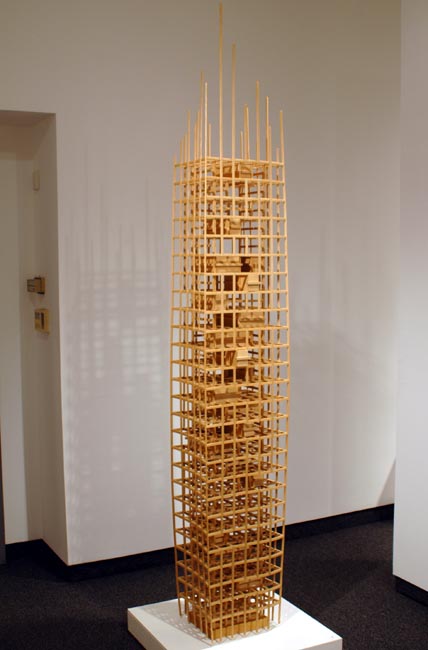
Being
ash
108" x 17" x 11"
2005
Yuri Kobayashi
In contrast, the small draws feel very intimate and private, as if they hold secrets, even though they are totally exposed. I found this contrast scary and uncomfortable, while at the same time, admirable. Additionally, notice how it is difficult to tell where the top ends. It seems to fade to nothingness, as if there is no separation between it and everything else. It is borderless/endless but still, very small and personal.
Being (closeup)
I also love her second piece, Current, and believe it is the equal of anything else in the show in spite of it being the smallest and "simplest" work on display. Though minimalist in design, it is skillfully constructed with a surprisingly technical complexity. She had taken nine strips of ash and bent them so that each piece retains its individuality as it rotates from being glued edge-to-edge on the left side to being glued top-to-bottom on the right.
Current
ash
18" x 45" x 7"
2013
Amazingly, as they shift, each strip has terraced edges rather than being sculpted smooth.
Current (second view)
The edges are most visible in the image below. Notice how the thickness of the strips also decreases as they overlap so she is able to maintain the full length of the strips without an incongruously thick stem.
Current (closeup)
Also notice the elegant finish to the stem.
Current (closeup)
Though Yuri's sculptures are certainly standouts, a number of pieces were exceptional by any standard of design or technical execution. Of particular note is Marc Fish's Mollusque. Unfortunately, the images I thought I took seem to have disappeared so I grabbed them from the gallery's site.
Mollusque
sycamore, glass, copper
32" x 72" x 41"
2012
Marc Fish
It is a phenomenal piece, made with copper and wrapped with sycamore (probably English sycamore, which is linguistically a little confusing because it is actually a maple - Acer pseudoplanunus). Amazingly, the wood is thin enough to fold around the tight curve but thick enough to carve ripples (and for this I wish I had my images) all around the piece, perhaps and 1/8" deep, that create an illusion of a beach-worn shell surface.
Mollusque (second view)
Curiously, in contrast to last year's show that had two equine pieces, this year there are three mollusks. The second one is by Joseph Walsh, also a low table sculpted as a weathered shell, again with a textured surface.
Erosion I - Low Table
rippled ash, olive ash, white oil
21" x 67" x 35"
2009
Joseph Walsh
With the treatment of the surface and the whitening (with oil) he is able to mimic the look of a time-sculpted shell.
Erosion I - Low Table (second view)
The third mollusk inspired piece is Alun Heslop's Razorfish (table). Again with a white ash, the piece resembles a wave sculpted sea floor with the razorfish making up the legs, seemingly poised to pop out of their holes. 
Razorfish III
ash
21" x 73" x 24"
2013
Alun Heslop
From underneath you get a better view of the holes. They remind me of Bart Niswonger's work, and perhaps were carved with the use of an industrial drill press, as Bart does.
Razorfish III (underneath)
Daniel Lacy's Chestless is innovative and interesting in how it is constructed without a chest for the draws to fit into. Instead, the draws slide on a rail system that is invisible from the front.
Chestless
British cherry, ash, Lebonon cedar
58" x 15" x 21"
Daniel Lacey
From the rear you can see how the draws slide. In addition, by creating a decorative crevice along the side that can be used as a handhold, he is able to maintain a sleek, clean line (void of handles) along the front.
Chestless (second view)
Michael Puryear's Asian influenced desk and chair combination, Win Jinan Shifu, is light in color and design. The seat and table top float above their bases as if levitating, creating a magical element to the work. 
Wei Jinan Shifu (chair)
English sycamore, wenge
30" x 29" x 22"
2005
Michael Puryear
Wei Jinan Shifu (second view)
Both pieces are impeccably designed and executed. I particularly like the high contrast lumber selection. Often I find this combination to be too jarring, but here, perhaps because the dark wenge helps to create an additional illusion of floating above the floor, it is particularly appropriate.
Wei Jinan Shifu (desk)
English sycamore, wenge
29" x 60" x 20"
2005
Michael Puryear
With this close up of the desk top, you can see the highly figured boards he used.
Wei Jinan Shifu (desk - closeup)
The last piece that I'd like to highlight is Reveal Chest of Draws by Waywood, a small team of furniture-makers in Chadlington, UK. It has such beautiful, flowing surfaces, again, uninterrupted by handles. It obviously inspired by nature but, at the same time, is elegant and contemporary.
Reveal Chest of Draws
walnut, maple, oak, Lebanon cedar
55" x 28" x 20"
2010
Waywood
From the side you can also see the handholds that allow for easy opening, and the decorative joining technique used in the draw fronts.
Reveal Chest of Draws (closeup)
And finally, I have to congratulate Gallery NAGA for curating such an ambitious, and expensive, show for the second year in a row. The logistics of working with so many artists from so many different places -- including the shipping, handling, and promoting -- is a remarkable feat that matches the accomplishments of the participants. It has been such a treat to be able to see, and touch, work that I would, otherwise, not even know about.

Thursday, July 1, 2010

Modes of Making @ Society of Arts and Crafts

The Society of Arts and Crafts curated an inspiring furniture show that also coincided with the Furniture Society Conference in Boston, titled Modes of Making, and exhibited June 5 to August 14. It features a wide range of art, some functional, some not; some contemporary, some traditional; mostly made of wood, but also some metal.

My favorite piece is, again, one made by Bart Niswonger. His F.O.M. Cabinet, which very much resembles Swiss cheese, is very inventive. I couldn't figure out how he cut the holes so I asked. It turns out he used a vertical mill, a tool I hadn't been familiar with but which is essentially a drill press on steroids used primarily for metal work. Bart made custom cutters for this piece.

FOM Cabinet
Bart Niswonger
I like how SAC painted the wall behind it green, making the piece really stand out. The rest of the gallery was painted off white. They must have thought a lot of it as well since they gave it the prime spot at the entrance.
I also really like this this table by Reagan Furqueron. It is a nice blend of functional and sculptural work with a little bit of humor.
Coffee Table w/Boot
Reagan Furqueron
Another piece with humor is My Casket by Shaun Bullens. The piece includes a video that you can see through a small peep hole on the right side. It shows Shaun pulling the coffin through city streets for about 30 minutes (I didn't watch the whole thing). I was told that the work was inspired by Herman Melville's Moby Dick. It combines fine woodworking, rough carpentry, video art, and conceptual art. The veneer of the base has a fiery motif on the far side as well. I think it is funny that someone would create a casket titled, My Casket, and have offer it for sale. If someone buys it, do you ask for it back when you need it?
My Casket
Shaun Bullens
This sculpture by Sylvie Rosenthal is also conceptual. Titled, Equilibrium: Balance III, it includes sixteen metal cubes engraved with words of emotion -- grief, love, fury, chaos, regret, temptation, joy, terror, compassion, loving kindness, vice, desire, clarity, greed, passion, forgiveness -- below a balance. It entices one to play and find out if these words really create an equilibrium. At least in her sculptural world, they do.
Equilibrium: Balance III
Sylvie Rosenthal
One of the more traditionally designed pieces is this finely crafted chair by Paula Garbarino. The design is original and with the narrow back rest and three legs, it has foot in the contemporary furniture world as well.
Begonia Tripod Chair
Paula Garbarino
Yuri Kobayashi created this purely sculptural piece, Believing. I'm not sure what the title refers to but it reminds me of early Wright Brothers airplanes, perhaps it has something to do with believing and accomplishing the impossible. It is certainly a very complicated construction, looking simultaneously fragile and strong.
Believing
Yuri Kobayashi

I had read on-line that it was made of ash and sterling silver before seeing it in person but couldn't figure out where the silver was so I made a point of looking closely when I got there -- she used silver pins to hold the through tenons in place.
Finally, Will Tracey created these cool Japanesque Flat Head Stools with cherry, poplar, and paint. Seeing them in person once again reminded me how different work looks in photographs. They were chosen for the show post card which somehow gave me the impression that they were much larger. At 18" high, they are actually a good stool height, but they have a very diminutive look that made me double check the dimensions.
Will Tracey
Flat Head Stools

Tuesday, December 1, 2009

Hurry, Buy Woodwork (Magazine) Now, Please!

Please, don't walk, run to your closest newsstand (or go online here) and purchase the annual issue of Woodwork (magazine). I picked up my copy yesterday and have to say that, in spite of the financial problems, it is still a tremendous resource for people interested in wood art. This issue features great profiles on both established (David Ellsworth) and emerging (Yuri Kobayashi) artists; an interesting perspective/review on wood art being shown at of the Philadelphia Craft Show; great images a number of wood art/furniture shows (congratulations to David Hurwitz for the inclusion of his large taffy mirror); an interesting article on Korean furniture/aesthetic; an interesting bio on Emil Milan; an good discussion by Andy Glantz on working with clients; and interesting articles by both Yoav Liberman and Michelle Janssens Keller on the thought process that goes into making a piece of furniture.

In looking through the magazine I noticed a disturbing lack of advertisements. Hopefully, if enough people run out and buy a copy (or copies - they could make a great gift) they can get more advertisements for future issues and continue to publish this great magazine. I think part of their problem is that they are straddling the worlds of woodworkers and art collectors/galleries but that the art collectors and galleries aren't aware of it. If collectors bought the magazine, galleries would advertise in it. Perhaps it is a tough sell, and maybe too specialized for the market, but I see their competition being closer to AmericanStyle and American Craft then it is Fine Woodworking. Perhaps they should scrap the furniture construction articles all together. I don't read them and I can't image people are buying it to find out how to build something. They look out of place and I'm sure most of there readers are beyond following someone else's designs. There are many other woodworking magazines that give step by step instructions on furniture construction and that appeal more to people that need it. In addition, those kinds of article would really intimated/alienate the collector/gallery readers. Their subtitle is "A magazine for all woodworkers" but that may be too broad a goal in the woodworking world while limiting their audience in the art/craft world.

Anyway, I hope they can continue to publish this important magazine and I beg you to go out and buy a copy. Once a year just isn't adequate and never again would be a tragedy.