Showing posts with label Gail Fredell. Show all posts

Wednesday, November 23, 2011

Asheville Trip Part III - Blue Spiral 1

The third wood art show that I saw in Asheville back in August was Wood Moving Forward at Blue Spiral 1, a beautiful gallery representing southern artists in a sprawling 15,000 square foot, three level space. This show was the most diverse in styles and scale of the three I saw on that day.

Bob Trotman had three larger than life busts of some very emotionally tortured individuals. This piece, Double Portrait of John, was my favorite. I had thought that the cutout sections might be draws so I asked at the desk and they were kind enough to demonstrate that the face could be changed.
Double Portrait of John
wood, tempera, wax, steel
Bob Trotman
By pulling out the large pin in the top of John's head (on the right side below), the eyes and mouth can be flipped. Interestingly, he actually looks more tense with his eyes closed. I like how the metal brace above his eye holds his head together, both physically and conceptually.
Double Portrait of John (alternate arrangement)
Here is the backside of Double Portrait.
Double Portrait of John (backside)
This second piece is also a "John" and I think it is a portrait of the same person on an even more stressful day.
John
wood, tempera, wax
Bob Trotman
This third piece, Jane, looks to me like she is being sucked into the earth but I also get the feeling she might be begging to be "taken with" during the rapture. As with Double Portrait, he has allowed the cracking in the wood to become an element of the piece, reflecting his subject's imperfections.
Jane
wood, tempera, wax, steel
Bob Trotman
I feel like I have spent an excessive amount of time thinking about this next piece, bmn508, by Hunt Clark. If it weren't in the show, I would have posted this review long ago. Amazingly, it seems to be carved from a single block of wood. In addition to the remarkable carving of consistently thin walls all along the irregular shape, I am mesmerized by whatever technique he used to create this piece without significant cracking, splitting, and warping of the lumber. I also find it fascinating how he made it look both natural and perfectly machined -- as if he extruded the wood through a metal die and he simply twisted the wood like it was clay. Further, his abrupt ninety degree turns with such delicate walls seem like they should have broken apart long ago. The whole thing just seems to be pure magic. On one level, I would like to know how he did it, and maybe even watch the process, but on another level, it is nice to know that magic is still possible and that maybe it is better left as a mystery.
bmn508
maple
Hunt Clark
As for the form that he has created, I find it interesting that he seems to be referencing traditional craft objects -- spoons, bowls, ladles -- but that they become twisted into something that is non-functional contemporary sculpture. As I always like to see functional objects turned into sculpture and this is just one more reason for me to like this piece.
bmn508 (second view)
Norm Sartorius also had several pieces in the show that do the same thing, turn craft into sculpture, but with very different technique, style, and scale. Although his "spoons" are clearly not intended to be used, they are created in the same scale as actual spoons, so in that way, they are paying homage to the craft of spoon making as much as they show respect for the trees that they are carved from.
The Emigrant
Afzelia lay
Norm Sartorius
Surprisingly, I find that the more I look at Sylvie Rosenthal's Journey to an Empty City, the more I think about (and try to remember) Gabriel García Márquez's One Hundred Years of Solitude because I feel it somehow captures the same kind of magical realism he captured (actually, the only thing I can remember from the story is that someone is carried away by ants, but I do remember the feeling of the book and I think this is it). One reason being that this piece seems to be telling a story, but it is a very fanciful story in which a city pops out of the middle of a ram like a picture in a pop-up book. Another being the contrast between the realistically carved ram and the construction of the city that is simultaneously haphazard and well crafted. Taken together, there seems to be both magic and realism. For me, the best part of the piece, though, is how it inspires the viewer to create a story around such a bizarre arrangement.
Journey to an Empty City
basswood, poplar, paint, mixed media
Sylvie Rosenthal
Robyn Horn's Spacial Disturbance is another interesting elaboration on her theme of creating the illusion of fractures and construction out of a single block of wood. I wish I had noticed that the materials included "ink" while I was in front of the piece so I could have looked more carefully at the edges. I assume that she used it to accentuate the "divide" between sections.
Spatial Disturbance
fiddleback maple, ink
Robyn Horn
The shadows she creates with her carvings emphasize the illusion of fractures and assemblage to the point that I'm not sure she needed to highlight it with ink but I'd need a closer look to see if that is what she did (I don't seem to be able to find any ink in the images). One interesting aspect of her design is how the linear carvings contrasts the natural curves in grain patterns. The lovely worm holes in this piece also help to accentuate the dichotomy between the natural material and the machine-like design.
Spatial Disturbance (close-up)
The only furniture piece in the show was this table, Glacier Point, by Gail Fredell. It was interesting seeing this piece after recently seeing her Bricklayer's Quartet at the Fuller Craft Museum. Both have the same distinctive style, but as I look at this one and remembering her other one, I think I'd really hate to put anything on either of them. Yes, they are technically tables, but their function seems to clash with their elegance. I think that people should be okay with buying tables that just meant for looking.
Glacier Point
cherry, painted soft maple, steel
Gail Fredell
And finally, I love the subtle humor and originality of Robert Lyons' turnings with pencils.
Getting to the Point
ash, pencils
Robert Lyons
I also appreciate how he takes an otherwise functional object and combines it with an everyday object to create pure sculpture.
The Mind Has An Eraser
basswood, pencils with erasers
Robert Lyons
After leaving Blue Spiral 1 it was too late to do anything but drink, however, while wondering over to a bar, my chauffeuse and I must have passed another ten galleries; and then, on the way to dinner, we must have past another ten. Clearly, there was way more art in this town than I expected. Although I limit my art writing to wood art, my aesthetic preferences are not at all limited by medium, so I was disappointed that I didn't get a chance to wonder through some more venues. Now I know, in scheduling future trips to Asheville, I need to allot more than a single afternoon for art.

Thursday, August 11, 2011

Furniture Divas @ Fuller Craft Museum

I recently visited the Fuller Craft Museum in Brockton, MA to see their Furniture Divas show (on view until October 30, 2011) that was curated my Meredyth Hyatt Moses. I was excited to see the show because it includes a number of my favorite artists and I knew it would also introduce me to great artists that I didn't already know about.

In reviewing this show, I know I'm leaving out a lot of great pieces by great artists but I have focused the discussion on a few pieces that really caught my attention, for purely subjective and often inexplicable reasons. The full list of exhibit artists includes:

Vivian Beer
Polly Cassel
Gail Fredell
Jenna Goldberg
Babara Holmes
Kristina Madsen
Sarah Martin
Wendy Maruyama
Judy Kensley McKie
Alison McLennan
Sylvia Rosenthal
Rosanne Somerson
Wendy Stayman
Leah Woods
Yoko Zeltserman-Miyaji

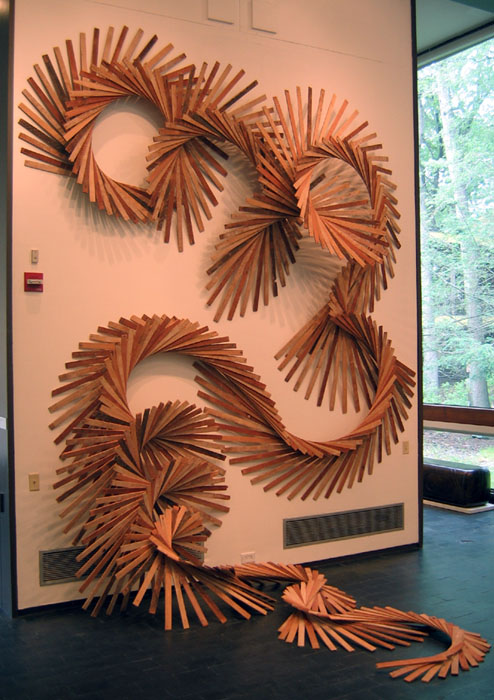
Although I'm not rating the pieces, if I were to select a favorite it would be this untitled reclaimed lath piece by Barbara Holmes -- not just because of my own personal bias toward non-functionality and cheapness of material, but mostly because of the pure joy and celebratory nature of the upward spirals. One of the nice things about the design is that it is a very organic, it doesn't follow a predictable pattern which makes it look alive as if it is climbing the wall right in front of your eyes.


Untitled
reclaimed lath
2011
Barbara Holmes


As I turned the corner into this room and looked to my right, my first thought was "What fun!" It was truly a very pleasant and unexpected surprise.
Untitled (closeup)

Also in the category of non-functionality this piece by Sylvie Rosenthal, Hope by Hope. I think it is safe to assume its title is a reference to hope chests, which I know nothing about other than what I've glanced at on this Wikipedia page. What I find most interesting about Sylvie's work is that it is pure sculpture that references furniture -- these "chests" don't open and they don't have bottoms. They seem to be calling for letters or notes (of hopes or wishes?) to be dropped into them but they aren't designed to hold anything physical so it really becomes more of a conceptual piece that asks for wishes, desires, or hopes in the form of thoughts. As such, I think it is really a meditative piece, which I believe is more valuable than something that holds stuff anyway.
Hope by Hope
2009
Sylvie Rosenthal


Additionally, in this closeup you can see how well crafted it is. The laths are made with mahogany and I particularly like their random widths, which makes the piece much more interesting. I think the birds are carved into the wood and I feel their presence plays well with the theme of the piece, perhaps in how fleeting and fragile hopes are, that they can easily spooked and fly away at any moment, never to be seen again.
Hope by Hope (closeup)

Another great piece that only has functionality in a theoretical sense (I don't think anyone would ever use it to hold anything) is Wendy Maruyama's A Question of Loyalty. It is made as part of her E.O. 9066 Series (which I mentioned in an earlier post here, in summary, the work references Executive Order 9066 which led to the interment of Japanese-Americans during World War II).


A Question of Loyalty
2010
Wendy Maruyama
The text on the sliding door reads:

Question 27: "Are you willing to serve in the armed forces of the United States on combat duty whenever ordered?"

Question 28: "Will you swear unqualified allegiance to the United States and faithfully defend the United States from any and all attack by foreign or domestic forces, and foreswear any form of allegiance or obedience to the Japanese emperor, or any other foreign government, power, or organization?"

With the door opened in one direction the answer is "Yes" but slid in the other, the answer in "No." Consequently, the viewer becomes a participant in the questionnaire that I assume Japanese-Americans must have had to respond to prior to their own internment.
A Question of Loyalty ("No" alignment)

Aside from the interesting conceptional aspect of the piece, from a design standpoint, I like the wormy ash that adds a lot of (perhaps metaphorical) character to it. It was made with "Tenafly white ash" which was a very old and esteemed ash tree from Tenafly, New Jersey that has found new life through the work of seventeen world renown artists (read the history and list of artists here). The organization tasked with preserving the tree through its second life as art, and the loaner of the piece to the show, is the Children's Tree and Art Foundation.
A Question of Loyalty (closeup)

Another sculptural piece with tangential functionality is Sarah Martin's Upward Mobility. In reading her discussion of this piece on her website, I learned that it was inspired by a record number of 17-year cicadas in the mountains of North Carolina while she was teaching at Penland School of Crafts.


Upward Mobility
2009
Sarah Martin


I was told by museum curator Perry Price, that each of the draws was a different size, fitting only in one opening, which I found interesting because in looking at the piece I wouldn't necessarily think that they were different. It is always interesting to learn about little things that artists do that only they know or care about. She could have saved a lot of time setting up her cuts to do them all the same and nobody would have known any better or have thought any less of her work, but instead, she took the time to make the draws and openings individually. It is a small but significant indication of an artists devotion to the piece and her craft.

Upward Mobility (closeup)

In addition, I'm impressed with her meticulous sculpting of all these bugs. They look almost as if she had somehow preserved the cicadas and just improved their appearance with gold and stone accessories.

Upward Mobility (closeup)

For functional pieces in the show, I was really drawn to, Gail Fredell's Bricklayer's Quartet. One reason being the fascinating slab of bog oak (a sub-fossilized tree 3,500 to 7,000 years old that was recovered from a bog in England) she used for the table top. I was also captivated by the inventive way she presents it, letting it float and be as natural as possible.

Bricklayer's Quartet
2011
Gail Fredell

It is also interesting how the bog oak's color is natural, no need to use any messy or time consuming fuming technique -- just stick a log in the ground an wait a few thousand years -- Gustav Stickley should have thought it, the result is a much richer color.

Bricklayers Quartet (closeup)

It is a little hard to see in this image but another aspect of the piece worth noting is the inventive way she stabilized the crack on the far end of the table with a steel bar underneath. A far more common method is to use a butterfly dovetail key that would span the crack, but her method leaves the crack completely natural, in all its beautiful imperfection.

Bricklayers Quartet (closeup)

I was also fascinated with this cut at the end of the board with the two small 90 degree angles. I couldn't figure out how she did it but the curator suggested, and I think he is right, that she removed a small section, perhaps rot or a large defect, and placed the section back together. Still, the shape of the cut is mysterious and intriguing, mostly because of the high level of craft she used to do it.

Bricklayers Quartet (closeup)

Another functional piece that captivated my attention is Kristina Madsen's Painted Chest. The first thing that drew my attention is its slightly diminutive presence, which I don't think translates in an image. It isn't small, but it isn't as large as you would expect it to be either. It somehow takes a scale that is unexpected, and in that way, calls attention to itself.

Painted Chest
2009
Kristina Madsen


It is also difficult to tell from the image but Kristina has intricately carved thin lines wherever you see white on this piece, the brownish yellow is milk paint. I find it interesting that she used maple for the case rather than basswood, which most people use for carving because it cuts easy and doesn't tend to tear-out. I'd be interested to know why she chose maple, perhaps because it is harder, and therefore more durable, than basswood but I wonder if it also allowed her to create thinner ridges between the grooves.

Painted Chest (closeup)

In this final image you can see the inside of the chest is lined with silk fabric but you can also get a better view of the fine carving on the outside.

Painted Chest (inside)
It is no secret that furniture making has historically been a very male dominated profession. In retrospect, it is almost hard to believe how, until very recently, exclusively male it was. In fact, I can't think of another prominent female furniture maker prior to Judy Kensley McKie's first museum shows in 1979. I even remember seeing a video of Sam Maloof embarrassingly recounting a story about how, when he first had women ask to apprentice with him (I think in the early 70's), that he had to turn them away because his employees refused to work with them. I know there were women who designed furniture earlier, such as Ray Eames and Charlotte Perriand, but women seemed to be excluded from the shop floor (it makes me think that there may be a good PhD dissertation in researching women in woodworking from earlier eras). As a result, one of the important aspects of this show is in demonstrating how unremarkable gender in the field has become. In just thirty years, women have gone from no recognition to, from what I can tell, equality (and please let me know if I'm wrong). In contrast, it is interesting to hear women in the fine art world still fighting for equality in museum collections and blue chip galleries (Joanne Mattera's Art Blog, among others, often raises the issue) but when I look at gallery and museum exhibits of furniture makers and woodworkers, women are always well represented. More than highlighting gender in the furniture world, this show seems to simply be a celebration that there are so many great female furniture makers working today that their gender is no longer relevant.