Showing posts with label Gallery Naga. Show all posts

Monday, July 15, 2013

Furniture With Soul II @ Gallery NAGA

This summer Gallery NAGA has organized a second show of artists featured in David Savage's book, Furniture with Soul: Master Woodworkers and Their Craft. For background, you can see the review I wrote last year here. As an added bonus, the show features even more artists from the other side of the Atlantic whose work is rarely seen in the US.

This year's show is equally great, with plenty of stunning work that truly push the boundaries of what furniture is and how it relates to art. Interestingly, I found my favorite piece to be one that was more conceptual than the others. Yuri Kobayaski's Being is emotionally powerful, conveying a tension between what is public, for everyone to see, and what is private, that perhaps we don't have a right to know about. It can be simply viewed as a chest of draws, however, it is really much more complex. Without any walls to protect the interior, the viewer can look right through it as if it has nothing to hide;
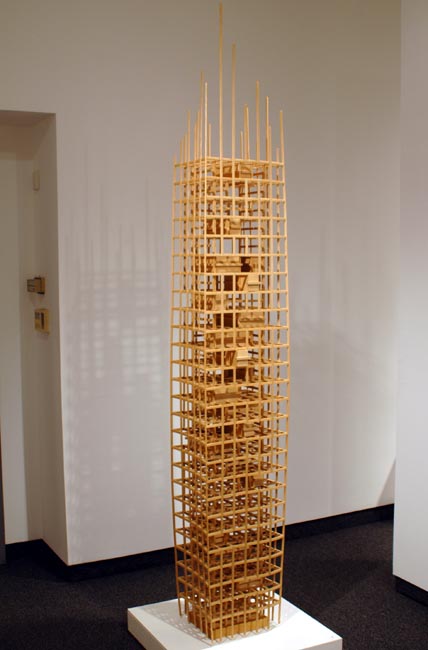
Being
ash
108" x 17" x 11"
2005
Yuri Kobayashi
In contrast, the small draws feel very intimate and private, as if they hold secrets, even though they are totally exposed. I found this contrast scary and uncomfortable, while at the same time, admirable. Additionally, notice how it is difficult to tell where the top ends. It seems to fade to nothingness, as if there is no separation between it and everything else. It is borderless/endless but still, very small and personal.
Being (closeup)
I also love her second piece, Current, and believe it is the equal of anything else in the show in spite of it being the smallest and "simplest" work on display. Though minimalist in design, it is skillfully constructed with a surprisingly technical complexity. She had taken nine strips of ash and bent them so that each piece retains its individuality as it rotates from being glued edge-to-edge on the left side to being glued top-to-bottom on the right.
Current
ash
18" x 45" x 7"
2013
Amazingly, as they shift, each strip has terraced edges rather than being sculpted smooth.
Current (second view)
The edges are most visible in the image below. Notice how the thickness of the strips also decreases as they overlap so she is able to maintain the full length of the strips without an incongruously thick stem.
Current (closeup)
Also notice the elegant finish to the stem.
Current (closeup)
Though Yuri's sculptures are certainly standouts, a number of pieces were exceptional by any standard of design or technical execution. Of particular note is Marc Fish's Mollusque. Unfortunately, the images I thought I took seem to have disappeared so I grabbed them from the gallery's site.
Mollusque
sycamore, glass, copper
32" x 72" x 41"
2012
Marc Fish
It is a phenomenal piece, made with copper and wrapped with sycamore (probably English sycamore, which is linguistically a little confusing because it is actually a maple - Acer pseudoplanunus). Amazingly, the wood is thin enough to fold around the tight curve but thick enough to carve ripples (and for this I wish I had my images) all around the piece, perhaps and 1/8" deep, that create an illusion of a beach-worn shell surface.
Mollusque (second view)
Curiously, in contrast to last year's show that had two equine pieces, this year there are three mollusks. The second one is by Joseph Walsh, also a low table sculpted as a weathered shell, again with a textured surface.
Erosion I - Low Table
rippled ash, olive ash, white oil
21" x 67" x 35"
2009
Joseph Walsh
With the treatment of the surface and the whitening (with oil) he is able to mimic the look of a time-sculpted shell.
Erosion I - Low Table (second view)
The third mollusk inspired piece is Alun Heslop's Razorfish (table). Again with a white ash, the piece resembles a wave sculpted sea floor with the razorfish making up the legs, seemingly poised to pop out of their holes. 
Razorfish III
ash
21" x 73" x 24"
2013
Alun Heslop
From underneath you get a better view of the holes. They remind me of Bart Niswonger's work, and perhaps were carved with the use of an industrial drill press, as Bart does.
Razorfish III (underneath)
Daniel Lacy's Chestless is innovative and interesting in how it is constructed without a chest for the draws to fit into. Instead, the draws slide on a rail system that is invisible from the front.
Chestless
British cherry, ash, Lebonon cedar
58" x 15" x 21"
Daniel Lacey
From the rear you can see how the draws slide. In addition, by creating a decorative crevice along the side that can be used as a handhold, he is able to maintain a sleek, clean line (void of handles) along the front.
Chestless (second view)
Michael Puryear's Asian influenced desk and chair combination, Win Jinan Shifu, is light in color and design. The seat and table top float above their bases as if levitating, creating a magical element to the work. 
Wei Jinan Shifu (chair)
English sycamore, wenge
30" x 29" x 22"
2005
Michael Puryear
Wei Jinan Shifu (second view)
Both pieces are impeccably designed and executed. I particularly like the high contrast lumber selection. Often I find this combination to be too jarring, but here, perhaps because the dark wenge helps to create an additional illusion of floating above the floor, it is particularly appropriate.
Wei Jinan Shifu (desk)
English sycamore, wenge
29" x 60" x 20"
2005
Michael Puryear
With this close up of the desk top, you can see the highly figured boards he used.
Wei Jinan Shifu (desk - closeup)
The last piece that I'd like to highlight is Reveal Chest of Draws by Waywood, a small team of furniture-makers in Chadlington, UK. It has such beautiful, flowing surfaces, again, uninterrupted by handles. It obviously inspired by nature but, at the same time, is elegant and contemporary.
Reveal Chest of Draws
walnut, maple, oak, Lebanon cedar
55" x 28" x 20"
2010
Waywood
From the side you can also see the handholds that allow for easy opening, and the decorative joining technique used in the draw fronts.
Reveal Chest of Draws (closeup)
And finally, I have to congratulate Gallery NAGA for curating such an ambitious, and expensive, show for the second year in a row. The logistics of working with so many artists from so many different places -- including the shipping, handling, and promoting -- is a remarkable feat that matches the accomplishments of the participants. It has been such a treat to be able to see, and touch, work that I would, otherwise, not even know about.

Sunday, September 23, 2012

Equines Rule in Furniture with Soul Show

Over the summer Gallery NAGA, in Boston, assembled an ambitious international show of top tier studio furniture artists that included makers profiled in David Savage's book Furniture With Soul - Master Woodworkers and Their Craft. I haven't read the book so I won't be providing any review here, but I have read reviews and from what I understand, it is an impressive survey of top tier US and British furniture makers. This show included artists that were featured in the first section of the book. Next year, Gallery NAGA is planning on exhibiting artists that were included in the second section.

Because these are the best of the best (though, as with any curatorial process, no one can agree who these should be and many of my favorites aren't in the book), it was a surprise to me that I would have such clear and definitive favorites in the show. Interestingly, they turned out to be pieces inspired by equines. First, there is this set of Zebra Cabinets made by John Makepeace, a British artist whose work I had never seen before.
Zebra Cabinets
black oak and holly marquetry, burnished lacquer interior
John Makepeace
2012
Seeing these pieces in person made me think that there weren't enough superlatives to describe them. They aren't just remarkably imaginative, playful, elegant, and refined, they are exquisitely perfect at every level of concept, design, and execution. "Breathtaking" would theoretically be a good word to use but it really doesn't do them justice.  
Zebra Cabinet (inside)
Zebra Cabinet (closeup)
And then there is Judy Kensley McKie's new Grazing Horse Table. No, it isn't wood, but as I've said before, I make an exception in reviewing Judy's work. It is typical of her designs in being graceful, elegant, and an original interpretation of an animal that so often depicted in art that it is hard to imagine a new take on it. She pushes the boundary of how a horse is perceived, keeping only what is essential for the viewer to understand the subject. I also like how she uses the strength of bronze to make such delicate legs and tail.  
Grazing Horse Table
Bronze
Judy Kensley McKie
2012
Grazing Horse Table (second view)
Though not a horse, John Cederquist's kimono cabinet, titled Big Kanji, is still a great piece. It is an innovative combination of marquetry, sculpture, painting, and furniture design. 
Big Kanji
mixed wood marquetry, analine dyes, epoxy resin
John Cederquist
2010
In spite of its sculptural form, it is still a very functional piece, but what I really loved about it was the mechanism for opening the big door. There is a lever underneath the small cabinet on the right that you pull and the door swings open very gently in a way that is reminiscent of a bank vault. 
Big Kanji (second view)
 
Big Kanji (third view)
In addition to his phenomenal Zebra Cabinets, John Makepeace had two very beautiful and unique Trine chairs as well as a stool made in a similar style. The chairs are made with alternating layers of laminated yew (light color) and 5000 year old bog oak (a natural, almost black, color).
Trine Chairs
5000 year old bog oak and yew
John Makepeace
1994
Trine Chair (second view)
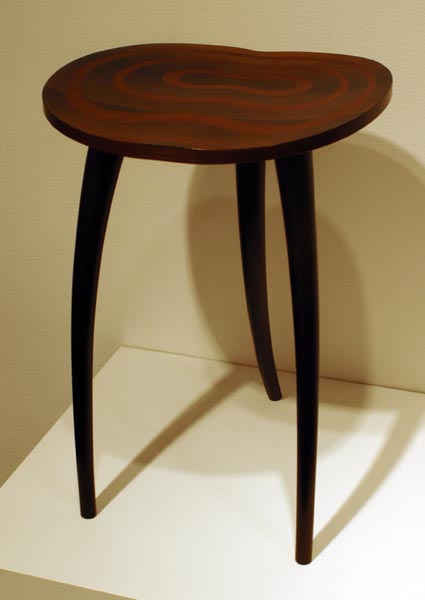
Though this stool seems to be made with a similar techique as the chairs, the concentric circles are actually made with marquetry rather than sculpted lamination.
Trine Stool
5000 year old bog oak and mulberry marquetry
John Makepeace
1994
Incidentally, in looking through a catalog of John's work, as well as his website, I am amazed at the complete mastery he shows of a wide range of styles and techniques. It really is a remarkable achievement. Especially considering most artists have very distinct styles that are instantly identifiable. With his work, however, the only consistency is an impeccable level of design and craft.

Garry Knox Bennett had three pieces in the show. First is this coffee table made with a nautilus shell. 
coffee table
claro walnut, nautilus shell, epoxy, color core
Garry Knox Bennett
2012
I think the nautilus shell really makes the piece, especially with Garry's splash of color.
coffee table (close-up)
Garry also had this combination desk/chair in the show. 
vanity with Z chair
rosewood, yellow satinwood, copper, paint
Garry Knox Bennett
2012
Every time I see one of Garry's Z Chairs, I'm amazed by the physics of them. I can't understand how anyone can make one of these things and not have it collapse like an accordion the first time it is used. But, because I know it is one of his signature pieces, and he has made many of them, I am completely confident that he has figured out a way to make it work - but it still doesn't seem possible to me, must be some form of magic.
Z chair (close-up)
A chair I did sit in, and I can attest to its absolute comfort, is Peter Danko's NoCo 2 Chair.  
NoCo 2 Chair
ash, Macassar ebony, die cut automobile tire, steel
Peter Danko
1999
Looking underneath, you can see he engineered some unique springs with automobile tires. Perhaps it should be called a "Goldilocks Chair" because the springs are stiff, but not too stiff, flexible, but not too flexible.
NoCo 2 Chair (close-up)
Having also sat in Peter's Atmos Rocker, I can say that he seems to have given an uncompromising priority to the user's pleasure.
Atmos Rocker
ash, lacquer, automobile seat belt webbing
Peter Danko
1999
Surprisingly, though Thomas Hucker's Side Chair looks as if a priority is given to its sculptural qualities, is also extremely comfortable. The back rest gives support, flexes, and provides the user with a very pleasing massage.
Side Chair
wenge
Thomas Hucker
2010
Michael Hurwitz's Twelve Leaf Resin Table is a captivating combination of nature-inspired art and engineering. 
Twelve Leaf Resin Table
ash, wenge, epoxy resin
Michael Hurwitz
2012
To get a sense of the enormous effort needed to create this table, check-out this time lapse video of the process Michael filmed while doing a residency at San Diego State University.
SDSU Artist-in-Residence Spring 2012: Michael Hurwitz from Matthew Hebert on Vimeo.
The contrast between the ash and wenge is particularly dramatic. In many situations it could be too much but with the soft tones of the leaves, it works very well here.
Twelve Leaf Resin Table (close-up)
I found Jack Larimore's Abide to be an interesting variation on a tête-à-tête, perfect for people that aren't on good terms.
Abide
paulownia, steel
Jack Larimore
2009
Abide (second view)
And finally, there is David Savage's Perseus, a chair named after the Greek hero famous for slaying Medusa. I suspect the multi-snake-like backrest is a reference to that story. To tell the truth, I didn't try it out because I didn't feel worthy. It looks very regal (perhaps that is the British influence). I'll have to wait for him to make something for common folk before I'll pass judgement on the comfort of his work.
Perseus
waxed English sycamore, Macassar ebony, applewood, and suede upholstery
David Savage
2010
Given the impressive line up of artists that was assembled for this show, and the quality of the pieces they provided for it, I look forward to the second half next summer. 

Thursday, May 3, 2012

Casting Convention Aside: Bart Niswonger @ Gallery NAGA

Having seen Bart Niswonger's work a number of times, I've known he was an innovative furniture maker, but his first solo show at Gallery NAGA is surprising in just how dramatically he has been able to innovate. Bart is clearly the type of artist that can't repeat himself. Though his previous work is good enough that he could spend a lifetime turning out variations of his existing designs, and I wouldn't begrudge him at all for doing it - any reasonable person would, instead he has used his previous work as just a starting point.


In this first piece, he has cast urethane in his trademark carved ash molds for the base, and created an ash top that he also used as a mold for two other pieces in the show. Though not over-powering in scale or design, I consider it, and its sister piece below, two of the most unconventional and innovative pieces of furniture I've ever seen. Conventionally, one would expect a table top to be flat (I don't remember ever seeing one that wasn't -- or at least wasn't supposed to be), but these have obstacles on them, creators that create a risk for someone placing a drink down on them without paying attention, it may spill. Though I have no idea what Bart's intention with this design was, I think the result is brilliant. It forces the user to pay attention to their actions. With these, you can't just blindly proceed through life, out of habit, not knowing what you are doing, rather, you are forced to think and be aware of your surroundings. The result is a mindful piece that I believe the Buddha would be appreciate. Though using them may not lead to enlightenment, I'm sure they can help move the user in that direction. Perhaps the world would be a better place if all tables came with such features. Maybe this will start a movement that Ikea will eventually catch on to -- we can only hope.

Black Side Table
ash, cast urethane, paint
2012
Black Side Table (closeup)
The simple base on this piece along with its understated opaque white top is in complete contrast to the radically unconventional design. 
Coffee Table
ash, cast urethane
2012
In this image you can see that the cast urethane picks up the ash grain pattern perfectly.
Coffee Table (closeup)
Given the pattern of the mounds in this medicine cabinet, I'm pretty certain it was also cast from the first piece. I like how the addition of yellow in the circles creates a complementary color that, along with the circle grain pattern, results in a nice, unique, polka dot effect. 
Medicine Cabinet
ash, cast urethane, paint
2012
Though Bart envisioned it as a medicine cabinet, I noticed on his website that he has a very broad understanding of "medicine" such that I wouldn't be surprised to see it holding Scotch in his own household. 
Medicine Cabinet (inside)
I'm not sure how the Buddha would feel about Bart's Ball Side Table but, aesthetically, it is my favorite piece in the show. I've seen him use this wave pattern (on the carcass) a number of times before but this time he decorated the peaks with random sized spheres, creating a very playful effect. But the really great thing he did with the piece is in casting a urethane (removable) top to provide a beautiful and interesting flat surface.
Ball Side Table
ash, maple, cast urethane, paint
2012
Aside from the obvious aesthetics, the reason I think this piece is so interesting is that he first cast the urethane on ash (you can see the grain pattern below, the imprint is on the underside) then, before the urethane fully hardened, he was able to imprint the spheres into it so that there is a perfect alignment between the two. 
Ball Side Table (closeup)
Remarkably, he was able to maintain the ash grain pattern in the urethane even as it was distorted by the spheres (you can barely see this below).
Ball Side Table (closeup)
In this final piece, Bart appears to have decorated the cabinet with cast flowers, but he actually used winter squash to create the molds.
Red Yellow Cabinet
ash, cherry, cast urethane, paint
2012
With the door open, you can see that though his work is conceptually radical, he still uses the finest traditional craftsmanship in his construction. 
Red Yellow Cabinet (inside)
By the way, in case you are interested in how Bart cuts the circle/holes in these pieces, as I learned in writing an earlier post, he uses a custom build vertical mill (a tool typically used for drilling in metal) that he modified for woodworking. A reasonable person would never consider going to the trouble but, thankfully, Bart is completely unreasonable.