On a recent trip to DC, I stopped in the National Gallery and found the Alexander Calder room. On seeing the exhibit there were two things that struck me; first, many of the pieces were made with wood; and, second, I didn't think the work was great!?! I found these points shocking because I had never previously considered Calder a wood artist and, second, I don't remember ever seeing any of his work that I didn't consider brilliant.
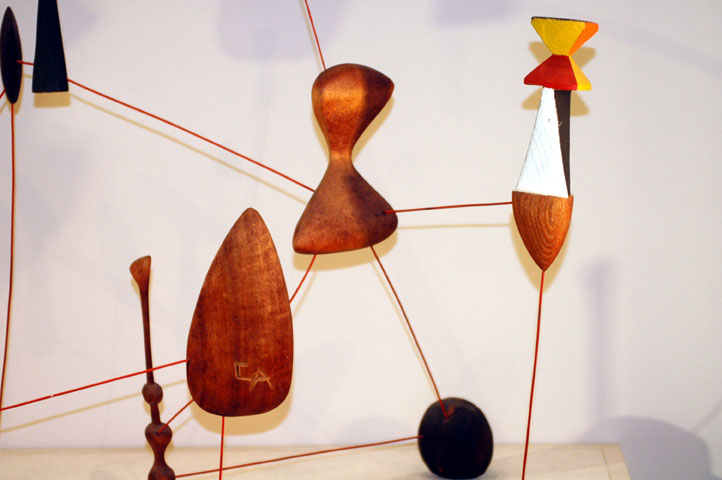
For example, there was this piece, Untitled (the wood mobile) that he made in 1943. Interestingly, though he is still playing with themes of balance that he often uses in his metal work, this piece combines odd juxtapositions in a clunky and inelegant form. The title is a bit confusing because it doesn't look like the piece moves, so maybe it is a joke, but even if it does move it can't have nearly the movement or elegance of his true mobiles.
Untitled (the wood mobile)
1943
Then there is this piece, Untitled (Constellation Mobile), which reminds me more of Calder imitators than the master himself. In addition to clunky, I would describe it as chaotic and incoherent. It doesn't seem to have any of the elegance or refined craftsmanship his work typically displays.
Untitled (Constellation Mobile)
1941
Untitled (Constellation Mobile) (closeup)
And here is his Vertical Constellation With Bomb, similar to Untitled (above) in its chaotic nature and irregular, seemingly unrelated but artificially attached, forms.
Vertical Constellation With Bomb
1943
Vertical Constellation With Bomb (closeup)
In comparison, here is a non-wood piece, Little Spider, in the same exhibit and constructed during the same period (I took the image off the Smithsonian website because I mistakenly didn't photograph thinking that I should only capture the wood pieces). I feel that it is unarguably a great piece -- elegant, light, well balanced, a fine combination of both complexity and economical design, gracefulness, while being completely original. Even in a still photograph it has movement. It is the kind of work that has made Calder Calder.
 Little Spider
1940
Alexander Calder
His Wikipedia page and the Calder Foundation Biography both say that he made these wood pieces during the war because metal was hard to come by. Maybe, though this Spider piece uses barely more metal than Untitled above and it is hard to believe that he didn't have a few more scraps laying around. In addition, he made pieces with wood from the beginning of his career to at least 1951. Perhaps it would have just been too embarrassing to be ostentatiously making all metal pieces at the height of the war.
I think that if he really intended his wood pieces to be a substitute for his metal work, they would have been more graceful and less quirky. Instead, it looks to me like he was just using the time and the medium to explore a different side of his artistic self. It reminds me of Matthias Pliessnig's quirky ad lib series that I mentioned in a post a couple of years ago. Matthias is famous for his gracefully swooping, wave-like benches, but he also makes odd little sculptures with found objects that don't seem to have any relationship to his benches. I think in both cases, and in my own experience, the mental intensity and physical demands of making something beautiful and elegant creates the need for a mental counter-weight, something that can let one part of your mind rest and while you do something different.
Work like this can be rejuvenating. On their own, this counter-weight art could easily be dismissed -- if this is all Calder made he likely would have long since been forgotten -- but in the context of his other work it is great, even if at first it is confusing, because of what it allowed him to make when he was ready to. I have no evidence, but I believe he made this work because he needed to and when some one asked him "why" he used the war as an excuse. I'd bet he also had a secret stash of odd pieces that he made in private much later that he just never wanted to show but which gave him the ability to concentrate on his monumental work. No evidence, but I'm just saying, I think this work is a glimpse into the another side of Calder he didn't show often.






 Posts
Posts


