Tuesday, September 27, 2011

Exceptional Wood Art @ Art Hop

This year's Art Hop in Burlington, VT was another successful event, perhaps the best yet. I'm amazed that in a such a small state, someone can organize an art event that includes well over 500 artists, over 100 studios and make-shift galleries, and draw tens of thousands art enthusiasts. I also love how it seems to be such a Vermont-ish event in that it is so egalitarian, everyone one is welcome and can find a space to display work. And artist of all levels do, successful professional artists can be seen right next to novices (many of whom are also very good). You know you won't like everything, in fact, you might not like most of what you see, but you never know what to expect and there are so many surprising gems, works by artists you've never heard of, that it is worth it to endure the marathon march it takes to see a majority of the work (seeing everything is not realistic for normal human beings).

I started on Friday, September 9, at 2:30 (two hours before the start) and finished at 10:00 and still hadn't seen close to everything but, coincidentally, I found the best wood art at both the beginning and end (I returned on Saturday and looked for a couple more hours but still didn't get to every venue, although, I have to admit, seeing all the venues would be infinitely easier if I didn't know anybody).

One of my first stops was Select Design, a brand development company, which always has high quality work in their space. I hadn't checked the show guide because it is too overwhelming to look through so I was completely surprised and very pleased to find that BigTown Gallery, of Rochester, VT, was exhibiting a number of their artists there, including Hugh Townley and Duncan Johnson.
Townleyberrybush
cedar threaded on metal
1960-62
Hugh Townley
Mrs. Crowlady
mahogany on painted base
1998-2006
Hugh Townley
I had previously seen this piece, A Brief History of Haley's Comet, at Hugh's retrospective show at the Fleming Museum a couple of years ago but this viewing gave me a chance to look at it more closely and seen how he constructed it. There are a lot of things I like about this piece, but what I really love is the wormy mahogany at the bottom which I assume plays the role of stars in this composition. The holes are so large that they look like they were drilled out but the lack of tear out along with some horizontal borings make me think that it could only have been done by some very large bugs.
A Brief History of Haley's Comet
mahogany relief
1984
Hugh Townley
There was also this plywood tondo that seems to be some kind of hieroglyphic story which I find indecipherable but I like the contrast between the commonness of the material and the fine craft that was used to construct it. (my image of this piece isn't great because of the lighting but you can view a professional version here).
Tondo 8
plywood relief
2000
Hugh Townley
With Michigan Avenue, it again seems that Hugh is telling a story that I can't decipher, but from the title I can hazard a guess it has something to do with a trip to Chicago.(Again, my image isn't great but you can find a better one here.)
Michigan Avenue
plywood relief
1999
Hugh Townley

Like Hugh, Duncan Johnson's paintings combine inexpensive (actually free) materials with fine craft. As I mentioned in a previous post, Duncan finds discarded wood at his local landfill or nearby construction sites.

What I love most about his work is looking at the wonderful colors people have used in their homes and how it generates so many questions. I wish they all came with a story -- the history of the house, the painter, where the color was used, the families that selected or lived with it -- but with a complete lack of information, my mind is left to wonder/wander all on its own. The colors in this one, Pilot House, I find exceptional, the range of blues, the pink, peach, reds, and then that one lime/yellow below the pink and green blue -- it seems like it was destined for art because I can't believe it ever made any sense inside or outside a house.
Pilot House
found wood, nails, and graphite
Duncan Johnson
Duncan also uses a lot of different size nails in his pieces, meticulously placed along vertical and diagonal lines. There are many more nails than could conceivably be needed to hold the piece together so that they become a form of decoration, bejeweling the wood. By using a range in sizes (I believe including 17, 18, 20, 21 and 23 gauge) they have the effect of giving the pieces a starry quality, especially on a darker piece like this one.
Shepards Gate
found wood, nails, and graphite
Duncan Johnson
With Winter's Weight, and a number of his other paintings, there is an interesting play between background colors and the dynamic, surprising ones. I find that my eyes spend a lot of time on specific colors, jumping around looking for the ones I like best. In this one, I really focus on the pinks and blues. (I had to photograph this one from an angle because of a barrier, you can see a professional image on Duncan's website here.)
Winter's Weight
found wood, nails, and graphite
Duncan Johnson
Filter Fall is a newer piece in which he didn't use any nails (a profession image of this piece is here.)
Filter Fall
found wood
Duncan Johnson
There were also a number of furniture artists in the same show. Lars Larsen and Rolf Kielman, a studio furniture maker and architect team, displayed a few of their production prototypes, with models of the design process, first with paper, then cardboard, then plywood. There chair and table are supposed to assemble without any hardware and can be shipped flat. Very elegant and economical designs.
Lars Larsen and Rolf Kielman
When I first saw this display from Modern Vermont, I thought the plywood sheet behind the chairs was the art and was actually a little disappointed to realize it was the CNC cutouts for the chairs in the front of the display. Again, a very economical design that is jazzed up with the colorful side panels.
Lincoln Brown
Modern Vermont
In stark contrast to the production furniture on display, there was also this intelligently minimalist hand-made curly birch table by Eyrich Stauffer.
curly birch
Eyrich Stauffer
My final stop of the night was RL Photo, where I found Clark Derbes' wonderful wood sculptures. He doesn't use any expensive equipment or elaborate techniques to make them. They are intentionally primitive in their construction (his primary tool is a chain saw) which may result in casual observers overlooking their playful sophistication.
Time Traveler
wood and paint
Clark Derbes
I needed to include a lot of images of each piece because one would be pointless. You really need to see them from multiple angles to get a sense of what is going on.
Time Traveler
wood and paint
Clark Derbes
This sculpture, Time Traveler, has twelve sides, cut at random angles, that, along with the recurring geometric paintings, results in an optical effect that dramatically changes the piece as the viewer moves around it. It actually seems to jump between two and three dimensions, and, unlike most sculpture, it gives a sense of being a completely different work when looked at from even a slightly different angle.
Time Traveler
wood and paint
Clark Derbes
In addition to being optically surprising, the primitive nature of their construction adds to their playfulness.
The Three R's
wood and paint
Clark Derbes
Although cleaned up a bit with a palm sander, the chainsaw leaves deep gouges and, to ensure an informality, he rubs dirt in them between coats of paint. The effect is to make them approachable and joyful.
The Three R's
wood and paint
Clark Derbes
Standing Room (left) and Elbow Room (right)
wood and paint
Clark Derbes
Standing Room (left) and Elbow Room (right)
wood and paint
Clark Derbes
Clark's unpainted Solid Box could probably be mistaken for a bench but given the amount of fun and informality that he imbues in his work, I'd guess that he wouldn't mind if it were used that way. Being that it is made of ash, I doubt you would hurt it and he'd probably like the effects wear would have on the wood (not that I'm recommending you sit on it, I'm a firm believer in the policy of always asking before touching the art).
Solid Box
ash
Clark Derbes
Solid Box
ash
Clark Derbes
This final piece, Hollow Red Form 2011, doesn't create the same optical effects as the others but it is also clearly made with a playful spirit. It makes me think of a child's toy, but not one of those boringly perfect factory-made toys, rather something constructed by a child in a time when imagination and spirit was all that was need to have fun.
Hollow Red Form 2011
carved and polychrome pine
Clark Derbes
Unfortunately, I wasn't able to get this post up early enough to encourage people to make it to this year's Art Hop (most of the work comes down at the end of September) but I strongly recommend it as a future destination. It is a truly great art event in being so open and welcoming to all kinds of people whatever their level of art sophistication or financial means. Anyone, from a child with a tooth fairy's bank roll to a serious collector with a corporate credit card, can find art that they can afford and appreciate for a lifetime.

Tuesday, September 13, 2011

Asheville Trip Part II - Grovewood Gallery

On my second stop during my recent Asheville trip, I went to the Grovewood Gallery where they were having A Wood Collector's Home show, featuring nineteen top wood artists from across North America, July 1 to October 2. Although there were a number of artists in this show whose work I saw at the Arboretum show, amazingly, there were a few phenomenal woodturners whose work were only in this show (maybe because they weren't AAW members). As a result I was a little overwhelmed and somewhat jaded by the quality of work by this point so, in looking back at the gallery's website, I can see that I skipped over and didn't photograph work that I would have otherwise covered.

Malcolm Tibbetts is one of the amazing artists I hadn't previously seen. He creates segmented woodturnings but, unlike anyone else's work I've seen, he must assemble, turn, cut, and reassemble multiple times to create these objects. It hurts my head trying to figure out how he did it. They are very confusing puzzles that must require some very elaborate clamping jigs to create. Check out his website to see more amazing work -- he even talks a little about how he made some of the pieces, but, not being a wood turner, it just confused me even more. His two pieces in this show are The Wheel on the Bus and

The Wheel on the Bus
myrtlewood and mesquite on granite base
Malcolm Tibbetts
this intestinally inspired(?) work, Perpetuity.
Perpetuity
carob on granite base
Malcolm Tibbetts
Another segmented woodturner in the show, who I hadn't seen before, is Curt Theobald. He had several of these elegantly turned and sculpted "eggs" on display, giving a modern twist on an ancient form.
Family
laminated and dyed birch, pernambuco, gold leaf, silverleaf
Curt Theobald
And there is Ray Feltz, a third segmented woodturner, who creates these breathtaking life-size eggs with thousands of matchstick-sized segments. His website includes images of his process here if you want to get an idea of how he does it.
Large Ribbon Egg
3816 pieces of blood wood, yellow heart, holly, and tulip wood
Ray Feltz
Small Ribbon Egg
3960 pieces of pink ivory, blood wood, holly, walnut, and lacewood
Ray Feltz
Also in this show was this piece by Stephen Hatcher. The design reminds me of skate eggs, which seem to find their way into a lot of art that I see, to the point that I see them even when their not there. Are these shapes skate egg inspired? I don't know but I like it either way.

Celestial Spheres
maple with translucent crystal mineral inlay, metal acid dyes, lacquer
Stephen Hatcher
Binh Pho's had a delicate vase in this show. I like how the natural red color in the box alder blends with the red paint he used, making it unclear whether the color is natural or painted. On a recent trip to Cleveland I saw one of Binh's cast glass pieces that he made from a piece like this. With all the negative space in one of these vases it doesn't seem possible that it could be cast in glass but I guess what makes great artists great is not being limited by what seems possible because I was told that he spent three years developing a technique to do it.
Nightingales
box alder and acrylic paint
Binh Pho

Nightingales (closeup)
I also ran across a couple of more pieces by Darrell Copeland. I particularly like the addition of a second color and form into this piece relative to the piece I saw at the arboretum. It makes me think that this one is more recent.
Harvest Moon II
cherry and acrylic paint
Darrell Copeland

And another piece by Christian Burchard. The title refers to the area of north Africa west of Egypt, which is new information for me. Perhaps he was thinking that the piece reminded him of wind swept sand dunes but this series always makes me think of flesh. They always feels very personal and very human while at the same time letting the wood be what it is in its most raw form. I find them very mystical in how they draw a visceral connection between people and trees.
Towards the Maghreb
bleached madrone burl
Christian Burchard
And finally, there where two great fish sculptures by Daniel Essig. This first one, a Gar, was in the show but the truly amazing one
Gar
mahogany, maple, mica, milk paint, handmade flax paper, tin, 19th Century books, fossils, shells, bones, insect wings, Coptic and Ethiopian binding
was upstairs in their furniture gallery. I love this learned and wise sturgeon, decorated with miniature hand made books (and you can lift them out of their mortises(?) to open them), sculpted old book page fins, and tons of other historical object it carries along. This species seems to play well with the themes of Daniel's work in that it is so ancient looking, seemingly unchanged for the 200 million years of their existence, much like his use of book-binding techniques that were developed at the beginning of the practice.
Sturgeon
carved and painted mahogany, handmade books, mixed media
And note the skate eggs floating below. Though I liked his piece I saw in the Renwick last year, this one seems to me to be more museum worthy. Hopefully, the right collector will make a generous contribution and, hopefully, the museum will find a way to let visitors open the books.

Wednesday, August 31, 2011

Asheville Trip Part I - North Carolina Arboretum

I was in Asheville, NC recently and was able to see three great wood art shows of which I plan on writing three blog post reviews. This first one is on the Fine Art of Wood: An International Invitational Exhibit of Woodturning, May 28 to September 6, at the North Carolina Arboretum. The show was facilitated with the help of the American Association of Woodturners as well as their local chapter the Carolina Mountain Woodturners.

The work in this show was truly exceptional, many of the top turners, worldwide, submitted work and I found it to be a real education in getting an overview of who's who in the turning world. Often when I go to a show I admire a lot of the pieces but there is usually one piece that stands out for me as the most captivating. In this show I couldn't pick a favorite. I've tried to do it but found that the attempt only resulted in a fifteen minute discourse about five or six different pieces.

With that said, this first piece is by the renown David Ellsworth, one of the godfathers of the modern woodturning movement. I like how he labeled the materials, "wood," because if you look at the piece, it just may have been some random piece of rotting wood pulled from an old wood pile, full of holes and mold/fungus but then turned (pun intended) it into an elegant vessel that transforms defects into beauty. The commonness of his material contrasts with and elevates his design.
Homage Pot
wood
David Ellsworth

In seeing the show I was very happy to learn about the work Graeme Priddle, a New Zealand artist who's work has been greatly influenced by Maori culture. The elliptical scars on its body really caught my attention because they remind me of trilobites and, besides being a lover of trilobites, I think they, along with the mat black color (from burning?) give it a real ancient relic look. But I also love the tusk like wood on the sides that utilize the heart and sap wood perfectly. My Asheville friend and chauffeuse for the day said she thought this was the most powerful piece in the show and I think she is right. It is small but conveys something really mystical. I had thought that the title might have referenced Maori culture but in checking with Graeme it turns out that it refers to the largest of New Zealand's tree ferns, Cyathea medullaris (Interestingly, I checked a second time with him to find out why it is called Mamaku Vessel if there is no Mamaku in the piece and he said he just likes the tree so much and wanted to dedicate the piece to it. And having seen pictures of it on line, I agree, it is a great tree. In fact, when I saw the image I had a flash back to a dream I had about 25 years ago, looking down into a valley and seeing what I thought was a forest of beautiful palm trees but I now realize they were Mamaku. I had also thought I was in Pakistan but I now know that the dream was set in New Zealand).
Mamaku Vessel
pohutukawa, mulga, copper, metallic thread
Graeme Priddle
Similarly, Jacques Vesery's piece, Second Sister from the Sky Forest, has a mystical feel to it, as if it is an ancient vessel that was left behind in the forests by a forgotten Indian culture, enveloped by moss or lichen but still retaining its beautifully executed original form.
Second Sister from the Sky Forest
madrone burl, curly oak, mica, acrylic
Jacques Vesery
Undulation by Tucker Garrison is just another of the many pieces in the show that just make you wonder, "how was that done?" I find the most amazing part about this piece being that he was able to maintain the same dimensions of the wood throughout all the undulations.
Undulation
cherry
Tucker Garrison
Andi Wolfe' Tesserae serai is both beautiful and fascinating. It probably isn't total coincidence that it reminded me of a pine cone when I first saw it because Andi is a plant systematics research scientist at Ohio State University and she uses plant biology for much of her inspiration. As she says in her blog post, this piece was inspired by the "microscopic landscape of seed coats." The title of the piece translates to "mosaic palace" and by bleaching the wood, she gave it a palatial feel.
Tesserae serai
Spalted Maple
Andi Wolfe

While looking at this piece by Hans Weissflog, a member of the Carolina Mountain Woodturners, Joe Ruminski, thankfully came over to talk to me about it and help to explain how it was made. The precision of this piece is breathtaking and it is hard to believe it wasn't made by some high tech computer aided lasers or routers, like Rich Tannen's work, but Joe assured me that it was all done on the lathe by hand and with only the aide of interior and exterior molds that he uses to mark the lines. If you can't tell from the image, the concentric circles on the inside and outside are perfectly cut only halfway through and with the same width for each circle.
Half Circle Stars Bowl
African blackwood
Hans Weissflog

In the category of trompe l'oeil sculpture is David Nittman's Raya de Negro. Although it looks like a woven basket, it is actually a wood turning that has been burned and dyed to create the pattern. This and the other piece he had on display at the show were both influenced by Native American designs but his website shows "baskets" that are influenced by African and Middle Eastern patterns. It is interesting that another artist, Lincoln Seitzman, also worked in the field of trompe l'oeil wood turned baskets but that both artists developed a completely different process and style. Who would think that a field so specialized could be so diverse?
Raya de Negro
European pear
David Nittman
In this closeup it is still difficult to tell it is a woodturning. Regardless of whether it is trompe l'oeil or not, the design is beautiful art that stands on its own.
Raya de Negro (closeup)
I find French artist Christophe Nancey's Empreinte to be a variation on trompe l'oeil in that he seems to have transformed his medium into something that looks more like stone. It reminds me of a volcano or a lunar crater.
Empreinte
oak
Christophe Nancey
Another French artist, Alain Mailland, created this great piece (apologies for the poor image), Octopus Garden. It is a good example of how he uses negative space to create weightless pieces that reference both ocean and floral imagery. It is all very organic but also thematic. As great as this piece is, I highly recommend checking out his website -- he has work on it that makes this look like it was made by an amateur weekend turner.
Octopus Garden
Alain Mailland
Binh Pho's Day Dream is a good example of how he integrates light and lightness into his work. It almost seems as if he is using paper rather than wood. I also like how he achieves balance through asymmetry, much like Caulder but not at all like Caulder.
Day Dream
maple, box elder, aluminum, acrylics
Binh Pho


The impossibly thin finials on Cindy Drozda's pieces are stunning. In reviewing her website I found it interesting that much of it is dedicated to her cats but her work seems to be decidedly un-cat friendly in that I can't imagine anyone with a cat being able to live with these sculptures. I guess that is why people make cases.

Metis (leftside)
eucalyptus gum vein burl, African blackwood with 4mm garnet
Green-Conscious (rightside)
masur birch, African blackwood with 4mm chrome diopside
Cindy Drozda
When I first saw Darrell Copeland's Enlightened, I was drawn to the gorgeous color and I loved the texture he carved into the surface (you can't see from this image but they radiate out from an off-center point) but in running into Joe Ruminski I was able to also learn that Darrell used seven colors of paint to get the effect (when I looked again, I noticed the variations, they really blend together well and must have taken a lot of time to create the effect) and that each of the squares are turned to create the concave shapes. It is a very beautiful and unique piece that combines painting and sculpture that is minimalist in form and color but complex in detail and execution.
Enlightened
cherry, acrylic
Darrell Copeland

Although an accomplished woodturner, this piece by Christian Burchard is one of the very few (only?) pieces in the show that didn't have any turning element to it. His work shows a real love of wood because he is just laying it out there -- "simple," raw, and naked. It really exemplifies the concept of wood as art as much as any work that I have ever seen.
A Certain Attraction
Bleached Madrone Burl
Christian Burchard
In 2009 he won the Society of Contemporary Craft's Founder's Prize and as part of the award they he made a video describing his process. I find it fascinating to watch because he shows how much work, and how much life, has gone into making something that looks so simple.


This final piece that I'll highlight is by Douglas Fisher, an artist from British Columbia who carves Native American designs into wood turned disks. His work is an interesting contemporary variation on a traditional art. In this piece I particularly like the off-set circles that frame the design, they give the piece more life, as if you are looking into a creatures eye and it is about to blink closed.
Yesterday is a Long Time Coming
maple
Douglas Fisher

Friday, August 19, 2011

Sawhorse Horses Installed for Art Hop

I just installed my Sawhorse Horses in Burlington for the Art Hop. They were on display last summer in Stowe, VT and if they don't sell by the end of this exhibit (which lasts until the end of September) they will be installed in front of the Vermont Arts Council here in Montpelier for two years. After today, I really don't look forward to taking them down and reinstalling them (it took about 3.5 hours to put them together) but both locations are great exposure and it will be nice not having to work on them for a couple of years. I also think it would be real groovy to see them covered in snow!
They are in front of the Maltex Building at 431 Pine Street, right across from the SEABA office, and, no, there isn't a train that uses the tracks currently.
I got a pretty good response for them while putting them together, although one guy wanted to know if they were dogs!?! Thankfully, a woman who was biking by a little later stopped to say "I love your horses!" I had to double check to make sure she didn't think they looked like dogs, which she assured me they didn't, so my fragile ego was assuaged.
I like this picture (above) the best.
I had hoped that the wood would have dried out a lot during the past year, and they would have, therefore, been easier to put together, but in storing them in a basement, I think they actually gained moisture since last summer. If they do sell in the next month, I think I'll build a dinosaur of some sort with the same materials for the Arts Council exhibit.

Thursday, August 11, 2011

Furniture Divas @ Fuller Craft Museum

I recently visited the Fuller Craft Museum in Brockton, MA to see their Furniture Divas show (on view until October 30, 2011) that was curated my Meredyth Hyatt Moses. I was excited to see the show because it includes a number of my favorite artists and I knew it would also introduce me to great artists that I didn't already know about.

In reviewing this show, I know I'm leaving out a lot of great pieces by great artists but I have focused the discussion on a few pieces that really caught my attention, for purely subjective and often inexplicable reasons. The full list of exhibit artists includes:

Vivian Beer
Polly Cassel
Gail Fredell
Jenna Goldberg
Babara Holmes
Kristina Madsen
Sarah Martin
Wendy Maruyama
Judy Kensley McKie
Alison McLennan
Sylvia Rosenthal
Rosanne Somerson
Wendy Stayman
Leah Woods
Yoko Zeltserman-Miyaji

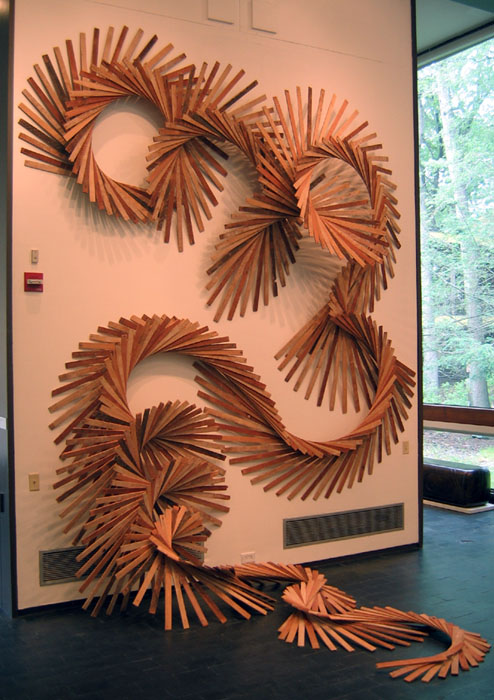
Although I'm not rating the pieces, if I were to select a favorite it would be this untitled reclaimed lath piece by Barbara Holmes -- not just because of my own personal bias toward non-functionality and cheapness of material, but mostly because of the pure joy and celebratory nature of the upward spirals. One of the nice things about the design is that it is a very organic, it doesn't follow a predictable pattern which makes it look alive as if it is climbing the wall right in front of your eyes.


Untitled
reclaimed lath
2011
Barbara Holmes


As I turned the corner into this room and looked to my right, my first thought was "What fun!" It was truly a very pleasant and unexpected surprise.
Untitled (closeup)

Also in the category of non-functionality this piece by Sylvie Rosenthal, Hope by Hope. I think it is safe to assume its title is a reference to hope chests, which I know nothing about other than what I've glanced at on this Wikipedia page. What I find most interesting about Sylvie's work is that it is pure sculpture that references furniture -- these "chests" don't open and they don't have bottoms. They seem to be calling for letters or notes (of hopes or wishes?) to be dropped into them but they aren't designed to hold anything physical so it really becomes more of a conceptual piece that asks for wishes, desires, or hopes in the form of thoughts. As such, I think it is really a meditative piece, which I believe is more valuable than something that holds stuff anyway.
Hope by Hope
2009
Sylvie Rosenthal


Additionally, in this closeup you can see how well crafted it is. The laths are made with mahogany and I particularly like their random widths, which makes the piece much more interesting. I think the birds are carved into the wood and I feel their presence plays well with the theme of the piece, perhaps in how fleeting and fragile hopes are, that they can easily spooked and fly away at any moment, never to be seen again.
Hope by Hope (closeup)

Another great piece that only has functionality in a theoretical sense (I don't think anyone would ever use it to hold anything) is Wendy Maruyama's A Question of Loyalty. It is made as part of her E.O. 9066 Series (which I mentioned in an earlier post here, in summary, the work references Executive Order 9066 which led to the interment of Japanese-Americans during World War II).


A Question of Loyalty
2010
Wendy Maruyama
The text on the sliding door reads:

Question 27: "Are you willing to serve in the armed forces of the United States on combat duty whenever ordered?"

Question 28: "Will you swear unqualified allegiance to the United States and faithfully defend the United States from any and all attack by foreign or domestic forces, and foreswear any form of allegiance or obedience to the Japanese emperor, or any other foreign government, power, or organization?"

With the door opened in one direction the answer is "Yes" but slid in the other, the answer in "No." Consequently, the viewer becomes a participant in the questionnaire that I assume Japanese-Americans must have had to respond to prior to their own internment.
A Question of Loyalty ("No" alignment)

Aside from the interesting conceptional aspect of the piece, from a design standpoint, I like the wormy ash that adds a lot of (perhaps metaphorical) character to it. It was made with "Tenafly white ash" which was a very old and esteemed ash tree from Tenafly, New Jersey that has found new life through the work of seventeen world renown artists (read the history and list of artists here). The organization tasked with preserving the tree through its second life as art, and the loaner of the piece to the show, is the Children's Tree and Art Foundation.
A Question of Loyalty (closeup)

Another sculptural piece with tangential functionality is Sarah Martin's Upward Mobility. In reading her discussion of this piece on her website, I learned that it was inspired by a record number of 17-year cicadas in the mountains of North Carolina while she was teaching at Penland School of Crafts.


Upward Mobility
2009
Sarah Martin


I was told by museum curator Perry Price, that each of the draws was a different size, fitting only in one opening, which I found interesting because in looking at the piece I wouldn't necessarily think that they were different. It is always interesting to learn about little things that artists do that only they know or care about. She could have saved a lot of time setting up her cuts to do them all the same and nobody would have known any better or have thought any less of her work, but instead, she took the time to make the draws and openings individually. It is a small but significant indication of an artists devotion to the piece and her craft.

Upward Mobility (closeup)

In addition, I'm impressed with her meticulous sculpting of all these bugs. They look almost as if she had somehow preserved the cicadas and just improved their appearance with gold and stone accessories.

Upward Mobility (closeup)

For functional pieces in the show, I was really drawn to, Gail Fredell's Bricklayer's Quartet. One reason being the fascinating slab of bog oak (a sub-fossilized tree 3,500 to 7,000 years old that was recovered from a bog in England) she used for the table top. I was also captivated by the inventive way she presents it, letting it float and be as natural as possible.

Bricklayer's Quartet
2011
Gail Fredell

It is also interesting how the bog oak's color is natural, no need to use any messy or time consuming fuming technique -- just stick a log in the ground an wait a few thousand years -- Gustav Stickley should have thought it, the result is a much richer color.

Bricklayers Quartet (closeup)

It is a little hard to see in this image but another aspect of the piece worth noting is the inventive way she stabilized the crack on the far end of the table with a steel bar underneath. A far more common method is to use a butterfly dovetail key that would span the crack, but her method leaves the crack completely natural, in all its beautiful imperfection.

Bricklayers Quartet (closeup)

I was also fascinated with this cut at the end of the board with the two small 90 degree angles. I couldn't figure out how she did it but the curator suggested, and I think he is right, that she removed a small section, perhaps rot or a large defect, and placed the section back together. Still, the shape of the cut is mysterious and intriguing, mostly because of the high level of craft she used to do it.

Bricklayers Quartet (closeup)

Another functional piece that captivated my attention is Kristina Madsen's Painted Chest. The first thing that drew my attention is its slightly diminutive presence, which I don't think translates in an image. It isn't small, but it isn't as large as you would expect it to be either. It somehow takes a scale that is unexpected, and in that way, calls attention to itself.

Painted Chest
2009
Kristina Madsen


It is also difficult to tell from the image but Kristina has intricately carved thin lines wherever you see white on this piece, the brownish yellow is milk paint. I find it interesting that she used maple for the case rather than basswood, which most people use for carving because it cuts easy and doesn't tend to tear-out. I'd be interested to know why she chose maple, perhaps because it is harder, and therefore more durable, than basswood but I wonder if it also allowed her to create thinner ridges between the grooves.

Painted Chest (closeup)

In this final image you can see the inside of the chest is lined with silk fabric but you can also get a better view of the fine carving on the outside.

Painted Chest (inside)
It is no secret that furniture making has historically been a very male dominated profession. In retrospect, it is almost hard to believe how, until very recently, exclusively male it was. In fact, I can't think of another prominent female furniture maker prior to Judy Kensley McKie's first museum shows in 1979. I even remember seeing a video of Sam Maloof embarrassingly recounting a story about how, when he first had women ask to apprentice with him (I think in the early 70's), that he had to turn them away because his employees refused to work with them. I know there were women who designed furniture earlier, such as Ray Eames and Charlotte Perriand, but women seemed to be excluded from the shop floor (it makes me think that there may be a good PhD dissertation in researching women in woodworking from earlier eras). As a result, one of the important aspects of this show is in demonstrating how unremarkable gender in the field has become. In just thirty years, women have gone from no recognition to, from what I can tell, equality (and please let me know if I'm wrong). In contrast, it is interesting to hear women in the fine art world still fighting for equality in museum collections and blue chip galleries (Joanne Mattera's Art Blog, among others, often raises the issue) but when I look at gallery and museum exhibits of furniture makers and woodworkers, women are always well represented. More than highlighting gender in the furniture world, this show seems to simply be a celebration that there are so many great female furniture makers working today that their gender is no longer relevant.